

The fifth episode of season 1 of HBO’s magnificent series Rome was entitled “The Ram has Touched the Wall.” The title was taken from the Latin phrase Murum aries attigit describing the Roman military policy in which, once a battering ram touched a city's walls, all offers of surrender were revoked and no mercy was shown to the defenders.

The phrase was brought to mind recently by news about the growing threat to the American Bar Association’s (ABA) lock on law school accreditation.
Former Northwestern law school dean Daniel Rodriguez recently posted to his Substack that:
Another shoe has dropped in the attack on the citadel of ABA law school accreditation. At the beginning of this month, Alabama announced reforms that bring it a more or less common place with Texas and Florida. Other states are actively considering similar reforms. At the same time, the ABA Council continues its internal evaluation (may we say reform?) efforts through the work of a special committee. Change in one form or another seems just around the corner; indeed, in the states just mentioned, it is already here.
Albeint with some caveats, Daniel blames the ABA’s troubles in part on the body within the ABA that oversees law school accreditation; i.e., The Council of the ABA Section of Legal Education and Admissions to the Bar:
Conventional wisdom among those (myself included) who have been strongly critical of the ABA’s accreditation performance is that many of the problems originate from within the ABA Council and management. … [T]he ABA accreditation team has been neglectful of external pressures to change their ways, and in some cases has double-downed on standards and approaches that are anachronistic and unimaginative ….
But he also blames “the legal academy itself,” by which he means “law school leaders and also invested, attentive law professors.” He criticizes the academy’s “deep conservativism,1 excessive caution, and lassitude,” which has caused the academy to fail “to construct models of and practices in legal education that are adaptive to contemporary conditions and circumstances.”
He points to several areas of failure:
Costs: “Law school tuition has ballooned over the past many decades.”
Learning infrastructure and the exceptionalist illusion: The gist of his point here is that the ABA has worked hand-in-hand with law school administrators to insulate law schools from “a university environment that strikes for general success and economies of scale.”
Transparency: “Law school leaders typically disclose only what they are forced to disclose.” Students and prospective students thus lack information that would make them better consumers.
All of which strikes me as quite correct. All of them speak to longstanding problems with the law school accreditation process and served as well springs of the present moment.
Yet, while they are the root causes, the immediate crisis lies in the politicization of the ABA and the legal academy.
Daniel alludes to the problem. He refers to the ABA accreditation bureaucracy as having “become politically toxic, as is the story of what will someday come to be called the Trump years.” He also refers to law schools being “especially vulnerable to external critics, especially from the Right currently, searching for reasons to press and sometimes even bully law schools to reconfigure their agendas.”
But why has the ABA and the legal academy become politically toxic?
Obviously, we live in an era of serious political polarization. The ABA and the legal academy have chosen a side. It is the side of progressive politics with all of its baggage.
A 2017 survey concluded that almost all law school faculties—especially at the top—lean sharply left:
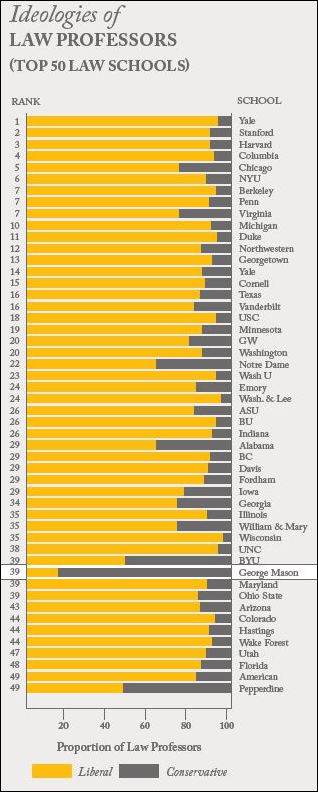
There is no reason to think the pattern has shifted in the last decade.
As for the ABA, there has been a steady leftward shift in the ABA’s political positions. As Jonathan Turley observes, starting with its 1992 decision to endorse abortion rights the ABA repeatedly adopted organizational principles and positions that leaned left. Each time it did so, more conservative and libertarian lawyers left the ABA. As each conservative lawyer left, of course, it became easier for progressive activists to ram through the next left-wing position. Today, ABA official positions include:
Opposition to the death penalty
Abolition of cash bail
Repeal of mandatory minimums
Opposition to religious freedom exemptions from discrimination laws
Gun control
ESG
DEI
Of all of these, however, it is the ABA’s position on DEI issues that has become the focus of the campaign to restrict its role in accreditation.
The ABA accreditation standards include # 206 on “Diversity and Inclusion”:
(a) Consistent with sound legal education policy and the Standards, a law school shall demonstrate by concrete action a commitment to diversity and inclusion by providing full opportunities for the study of law and entry into the profession by members of underrepresented groups, particularly racial and ethnic minorities, and a commitment to having a student body that is diverse with respect to gender, race, and ethnicity.
(b) Consistent with sound educational policy and the Standards, a law school shall demonstrate by concrete action a commitment to diversity and inclusion by having a faculty and staff that are diverse with respect to gender, race, and ethnicity.
To which the Council added an “interpretation” clearly aimed at California state law schools subject to Proposition 209:
The requirement of a constitutional provision or statute that purports to prohibit consideration of gender, race, ethnicity, or national origin in admissions or employment decisions is not a justification for a school’s non-compliance with Standard 206. A law school that is subject to such constitutional or statutory provisions would have to demonstrate the commitment required by Standard 206 by means other than those prohibited by the applicable constitutional or statutory provisions.
In February, the Council suspended that provision until August 31, 2026. On May 8, the Council’s committee that drafts its accreditation standard announced a recommendation that the Council repeal Standard 206.
In addition, Reuters reports that:
The ABA council on Friday will also consider eliminating a rule adopted in 2022 that requires law schools to educate students about bias, racism, and cross-cultural competency, as well as a proposal to drastically pare back, opens new tab its non-discrimination rule for students and faculty.
So what do we make of all this?
The ABA is basically a left-wing bully. It espouses progressive politics and pushes them on to a target—the legal academy—all too willing to cave in. But, like most bullies, it’s a coward. When it gets pushback, it caves.
The ABA could have stood its ground. It could have said something along the lines of “We adopted these DEI policies. We stand by them. Come and have a go if you think you're hard enough.”
But it didn’t.
It seems the ABA is desperate to maintain the appearance of relevance. It’s membership has shrunk to about 17% of the legal profession. It’s only claim to speak for the profession is its role as the gatekeeper to judicial nominations (now thankfully squashed) and law school accreditation.
Take away its role as law school accreditor and it will be exposed as what it is: Just one of the many left-wing interest groups making up the progressive alliance.
The ram has touched the wall. The Trump administration should have no mercy on the ABA.
I’m quite confident that Daniel does not mean political or social conservatism. Instead, what I think he means is what Merriam-Webster lists as a secondary definition of conservatism; namely, “the tendency to prefer an existing system or situation and to be cautious about or suspicious of change : strong resistance to innovation.”