

A few days ago, Tom Nichols of The Atlantic (a.k.a. @RadioFreeTom on X) reposted a tweet (do we still call them that?) presumably prompted by his ongoing beef with Vice President J.D. Vance:
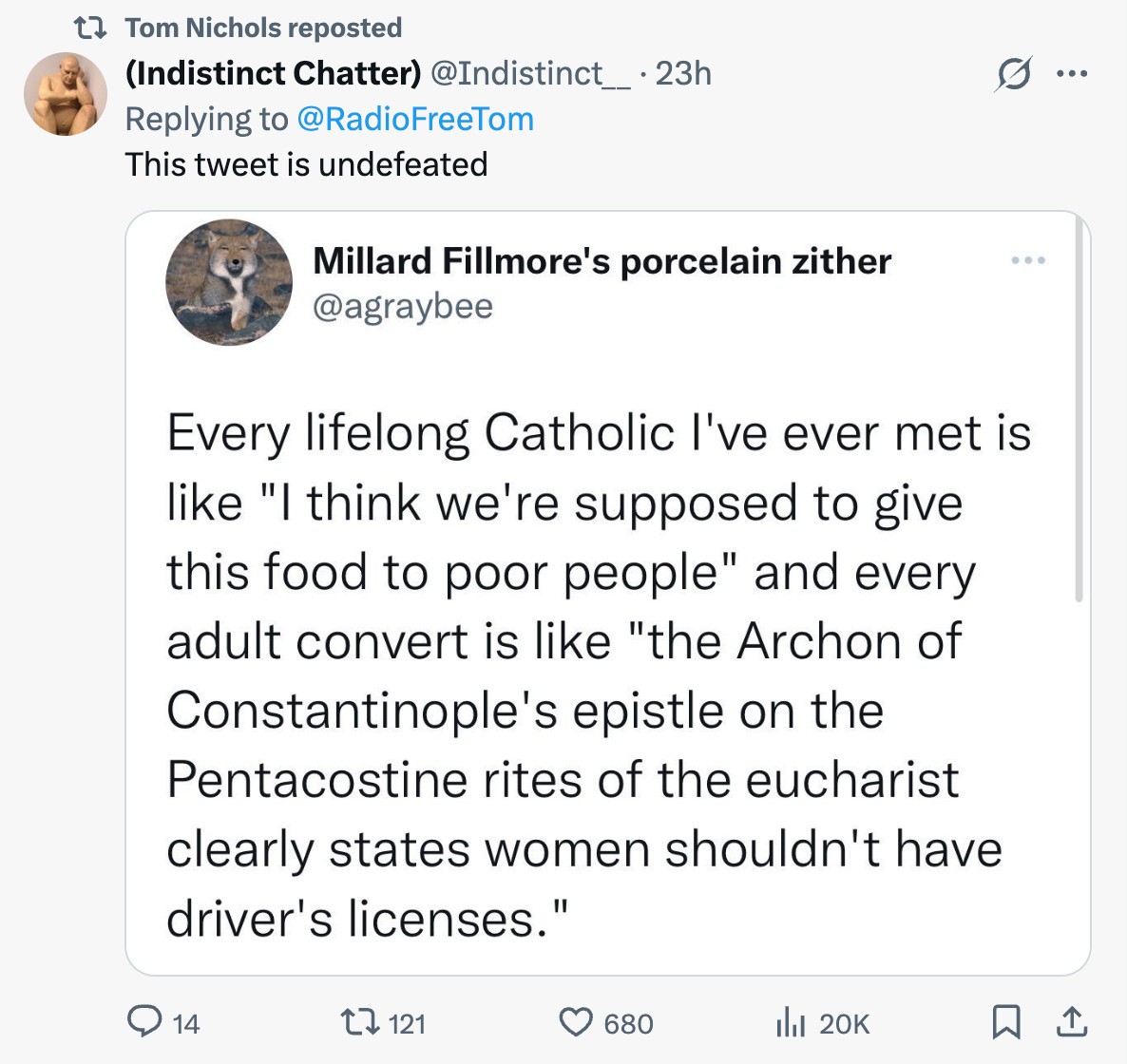
As an adult convert to Catholicism, I found this tweet deeply offensive.
Don’t get me wrong. I agree with the substance of Nichol’s critique of many of J.D. Vance’s pronouncements on the intersection of faith and religion. As many folks have observed, not just Nichols, Vance has a tendency to “mansplain” Catholicism to priests, bishops, and even the Pope himself. Not infrequently, moreover, Vance gets it wrong.
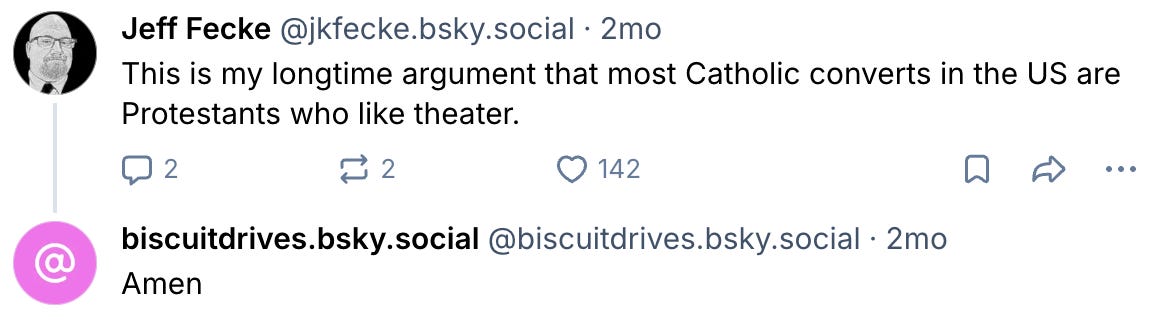
The trouble I have with Nichols—and many others—is the incessant harping not on what Vance says but when Vance became a Catholic. E.g.:
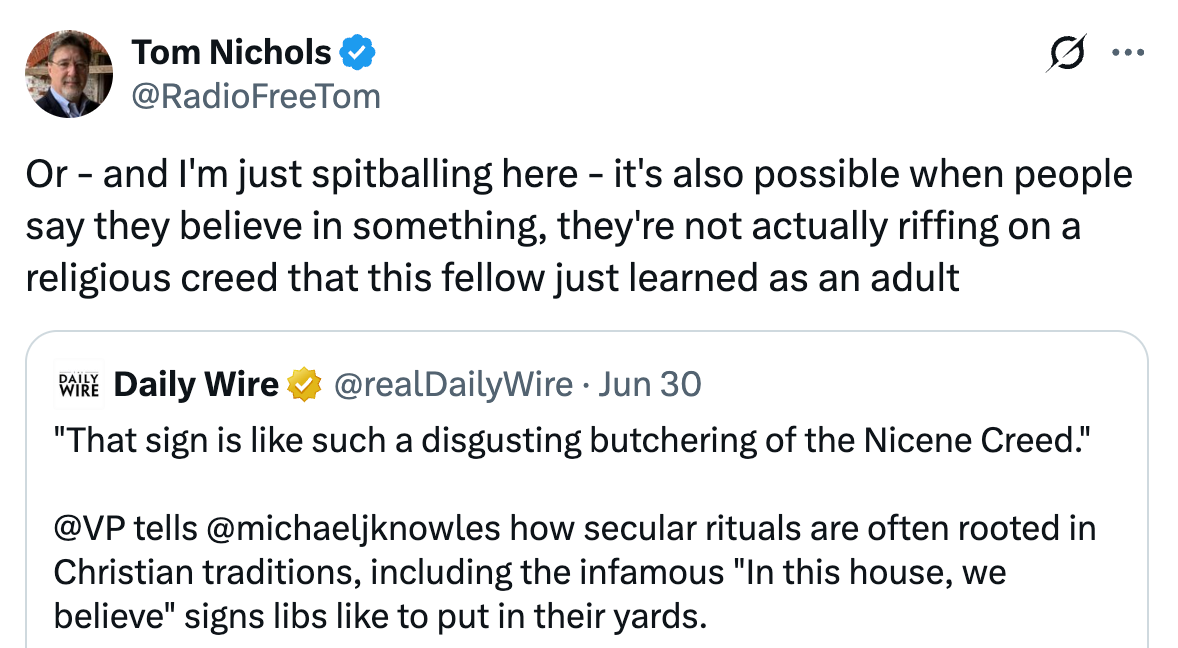
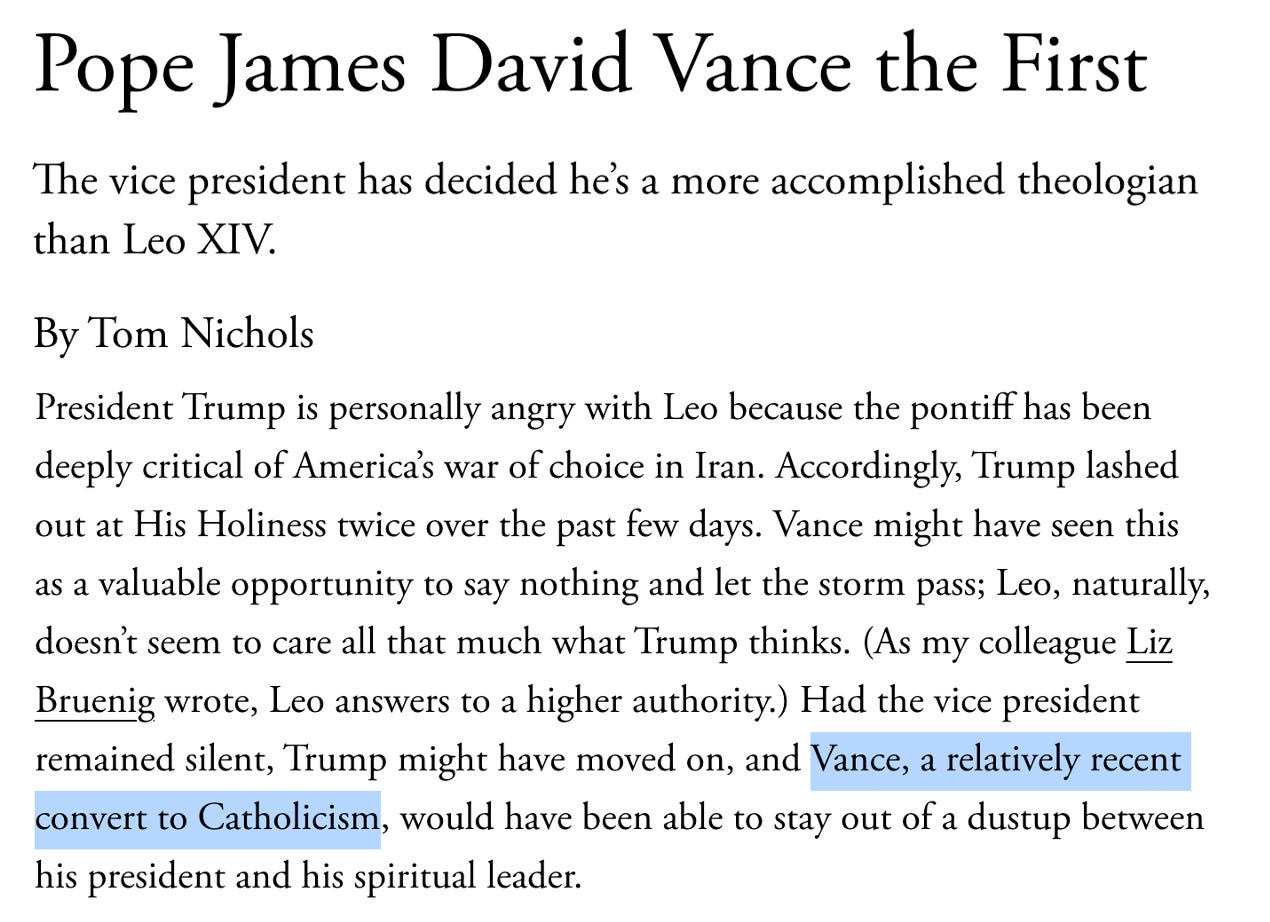
Why exactly does it matter when Vance learned the creed? Why do commentators like Nichols incessantly harp on Vance’s status as an adult convert? Why do they repost comments that feed into and perpetuate stereotypes about adult converts?
So let’s think about some of those stereotypes.
To be clear, I’m not saying Nichols or the other commentators I’ve cited necessarily hold or expound these stereotypes. I’m just saying that the focus on Vance’s conversion date helps perpetuate them.
Stuff Cradle Catholics Say About Adult Converts
It is considered axiomatic among cradle Catholics that adult converts are the worst. … [T]oo many adult converts see all of this incense-stained filigree as the real message of the gospels. And the American members of the species are also particularly interested in political power and the means to acquire it.”
Jana Bennett (herself a convert):
I have heard people complain that converts do not really understand Catholic theology because they bring Protestant habits with them about reading scripture, about discussing topics like God and that good old faith versus works debate; I have been privy to a few academic searches where people have discussed whether a convert would really be a good fit for a department; I have heard converts denounced as people who ruin the church because they are “more conservative” than the “real” Catholics.
Paul Chu and V. J. Tarantino in an open letter to JD Vance:
There is a familiar nostrum, applied to certain new converts to Catholicism – to wit, that they think that they’re more Catholic than the Pope. While such may not be a fair evaluation in most cases, let it be said that you have today, in this respect, set a new benchmark.
Being more Catholic than the Pope is annoyingly common behavior from converts, especially converts with Evangelical backgrounds. It’s very odd.
Some Data
Catholic converts are slightly more likely to attend Mass weekly, pray daily, and got to confession:
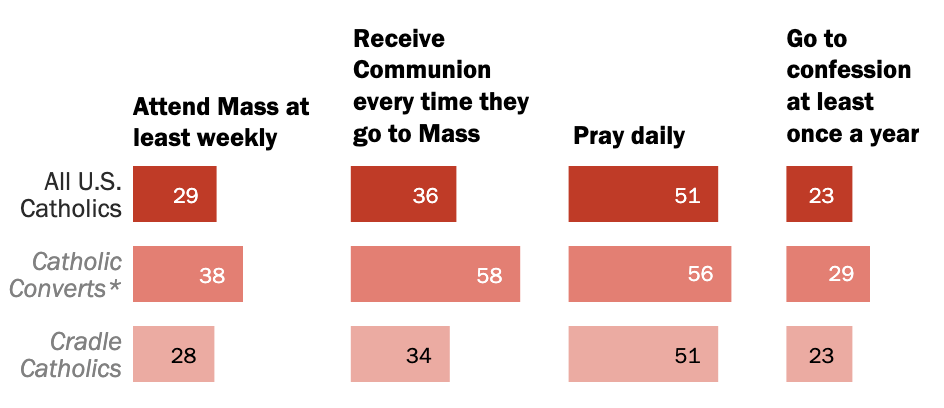
Those numbers are disappointing on both sides, of course.
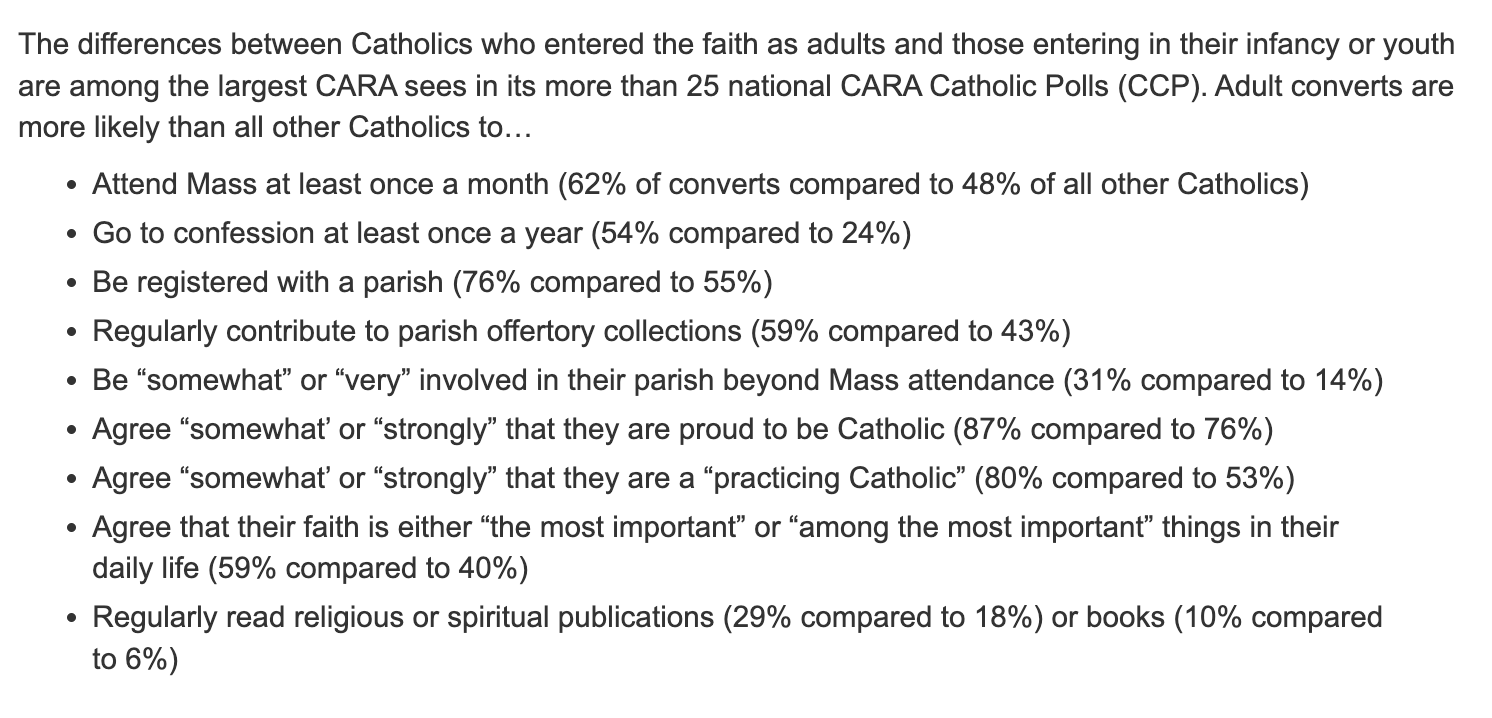
With reference to the repost that started me on this discussion, note that the percentage of adult converts who regularly contribute to their parish is 16 points higher than that of cradle Catholics.
With respect to practicing what the Church teaches, adult converts are more likely to believe in a core teaching of the Church; namely, the Real Presence:
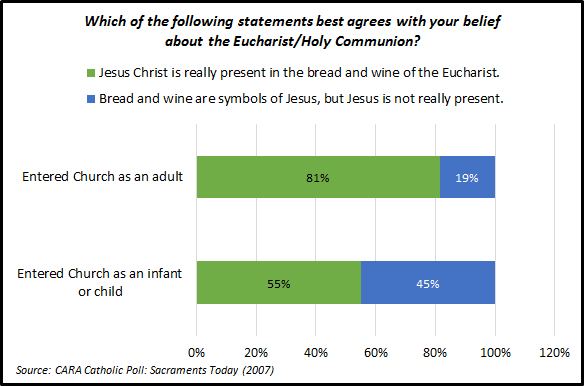
As noted by the Center for Applied Research in the Apostolate (CARA) at Georgetown University, which was the source for the above data:
Why would adult converts be more knowledgeable and believing than other Catholics? Perhaps it was the eight months to a year they spent studying intensively in an RCIA program? … It appears that having an intensive religious education experience as an adult has a more lasting effect than relying on religious education in the childhood years alone.
The Point
My point emphatically is not that adult converts are better Catholics than cradle Catholics.
My first point is that the stereotypes about adult converts we encounter in social media and the news media are sweeping generalizations frequently motivated less by faith than by politics.
My second point is that maybe all of us who are Catholics—whether as adult converts or from the cradle—should think before we speak. We should emulate Christ, who prayed that his Church “may all be one, as you, Father, are in me and I in you, that they also may be in us.”