

Ronald J. Colombo is a professor at Hofstra School of Law, where he teaches Business Organizations (a man after my own heart), Securities Regulation, and Contracts. The latter of which is most pertinent to his new paper, A Contractual Analysis of Petitionary Prayer.
Colombo is a prolific scholar, much of whose work can be easily grouped within the Christianity and the Law genre. So he’s well equipped to tackle a project like Petitionary Prayer.
Petitionary Prayer is a particularly ambitious interdisciplinary project. In it, Colombo argues that we can gain useful insights into the theology of prayer by examining it from a legal perspective.
To be clear, Colombo does not set out to prove that petitionary prayer works. Instead, he assumes arguendo that the mainstream Christian understanding of prayer is valid. He then asks whether statements such as “ask, and it shall be given you” (Matthew 7:7) can be understood as analogous to a legally enforceable promise.
FYI
Christian traditions identify anywhere from four to seven types of prayer. The basic four are adoration (praising God), intercession (asking for what others need), thanksgiving (gratitude for what God has given and done), and petition (asking for what we need, including both physical and spiritual needs such as forgiveness).
Note that petitionary prayer is not a mechanism for changing God’s mind. Instead, drawing on Augustine and Aquinas, Colombo explains prayer as a means through which humans participate in divine providence and align their desires with God’s will.
The Chief Difficulty with Petitionary Prayer
Colombo identifies a dozen New Testament passages in which “the Bible records Christ telling his followers ‘ask, and it shall be given you,’ some variation thereof, or some advertence thereto.”1
The central difficulty with petitionary prayer is that God does not in fact always give us what we ask for. No matter how earnestly I ask God for a pony, it is highly unlikely that a pony will appear on my doorstep one morning.

Some commentators try to explain this apparent contradiction away by saying that “sometimes the answer is no.” But that really doesn’t work. After all, the promise is that if we ask, God will give.
Colombo’s Thesis
Colombo’s central insight is that the apparent contradiction between “God promises to answer prayer” and “prayers sometimes go unanswered” disappears if we look at petitionary prayer through a contract law lens.
The basic definition of a contract is “a promise the law will enforce.”2 Note that that definition implies that the law will not enforce all promises. That proposition is made explicit in the Restatement (Second) of Contracts’ definition of a contract, which is “a promise or a set of promises for the breach of which the law gives a remedy, or the performance of which the law in some way recognizes as a duty.”3
The law will not enforce a contract that is not supported by consideration, for example. The law will not enforce a contract if one or both of the parties lack capacity. The law will not enforce promises to commit an illegal act. And so on.
Mapping Petitionary Prayer to Contract Law
The basic claim of Colombo’s argument is that petitionary prayer usefully maps onto contract law:
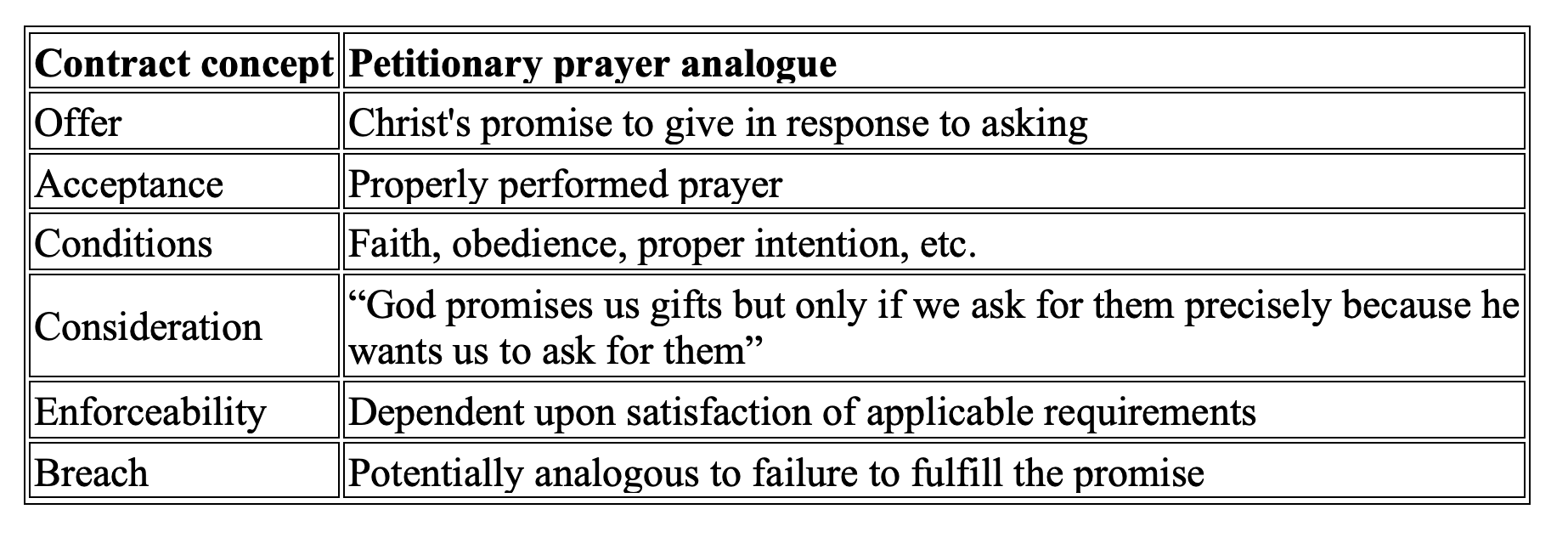
Unless all of these elements of an enforceable contract are met by the petitioner, the promise was not broken.
The Question of Conditions
Although Colombo works through all of the basic elements of an enforceable contract, to my mind the critical insight has to do with the question of conditions.
The law will not enforce a promise that is subject to conditions that have not been satisfied. “A condition is an event, not certain to occur, which must occur, unless its non-occurrence is excused, before performance under a contract becomes due.”4 The Restatement offers the following illustration:
A contracts to sell and B to buy goods pursuant to a writing which provides, under the heading “Conditions of Sale,” that “the obligations of the parties are conditional on B obtaining from X Bank by June 30 a letter of credit” on stated terms. The quoted language is a term of the agreement (§ 5), not a condition. The event referred to by the term, obtaining the letter of credit by June 30, is a condition.
If B fails to obtain the letter of credit by June 30, the contract will be unenforceable.
Colombo asserts that Christ’s promise is a conditional one and identifies multiple conditions including faith, proper intention, perseverance, obedience, forgiveness, remaining in Christ, and conformity with God’s will. Thus, an unanswered prayer does not necessarily represent a broken promise by Christ, but rather may represent a failure by the petitioner to satisfy the promise’s conditions.
Some Questions
Is There a Bargain?
It seems to me that the paper’s chief vulnerability lies neither in its theological analysis nor in its statement of the law. Both are accurately and skillfully laid out. Instead, it seems to me that the core question is whether Colombo has adequately justified the move from theological promise → legal offer → enforceable contract.
Colombo argues that argues that Christ’s repeated statements—such as “ask, and it shall be given you”—satisfy the requirements of an offer because they communicate a willingness to provide what followers request. A conventional contractual offer is ordinarily understood as an invitation to enter a bargained-for legal relationship. But the pertinent biblical passages are embedded in religious teachings about faith, salvation, obedience, providence, and one’s relationship with God.
The idea of a bargained-for relationship with God is clearly apt with respect to God’s relationship with Israel in the Old Testament. It is repeatedly described as a covenant between God and Man. God promised Israel land and safety if the people follow His laws and warned of punishment if they break the Law.
Although Colombo devotes some attention to the question (see pp. 33-34), I’m doubtful that a Christian understanding of our relationship with God is one for which we have bargained with God. Indeed, at least as I understand it, Catholic theology rejects the idea that a human being can negotiate with, manipulate, or place God under a legal or financial obligation. Instead, Catholicism frames the divine-human relationship through the lenses of covenantal love, familial adoption, and the absolute primacy of unmerited grace.
I gather Colombo would respond that he’s talking about a specific aspect of our relationship with God not the entirety of that relationship. He would also point out that he argues at 33 that “bargained for” is a “legal term of art” that “does not necessarily connote haggling or similar such conduct colloquially associated with ‘bargaining.’” Rather, ‘bargained for’ means that the aforementioned benefit or detriment is what induced the promissor to make the promise in question.” In turn, he argues that God benefits because “God wants our prayers” and we suffer “[t]he detriment of perseverance in prayer . . ..”
Query, however, whether that approach is consistent with Augustine and Aquinas’ portrayal of petitionary prayer not as a way by which we supply information to God but rather as a means for our participation in divine providence and our own transformation.
Is the Framework Explanatory?
It’s fairly easy to identify the conditions on Christ’s promise. Some are stated fairly explicitly in the Bible, while others have been developed through the Magisterium. But this raises the question: Does the contractual framework genuinely explain unanswered prayer, or does it make virtually any outcome compatible with the original promise by continually adding conditions that cannot be independently verified? For example, “ask according to God’s will” is a recognizable theological qualification. But determining whether a particular request actually conforms to God’s will is extraordinarily difficult, as Colombo recognizes:
This is a factual question, and my inclination is, admittedly purely speculative, but it seems to me that few supplicants formulate their prayers “in Christ’s name” and maintain them with the proper level of perseverance.
I’m okay with that. After all, well-founded speculation is at the core of the academic enterprise.
I’m also okay with it because I don’t think Colombo is arguing that Christ’s promise is in fact a contract. Instead, I see Colombo as making an analogy-driven argument that contract doctrine provides a useful vocabulary for organizing theological explanations of unanswered prayer.
Conclusion
The paper’s most intellectually interesting move is not simply its comparison of prayer with contracts, but its attempt to transform a theological paradox into a question about conditional promises. Its considerable strength is that the legal analogy helps us to identify the qualifications already present in the biblical and theological material. Its principal weakness is that the legal analogy strains because crucial conditions—especially God’s will, salvation, and the ultimate goodness of an outcome—cannot be independently verified in the way contractual conditions ordinarily can.
Even so, I liked this paper a lot and highly comment it to your attention.
Colombo, Ronald J., A Contractual Analysis of Petitionary Prayer (March 18, 2026). 25 Ave Maria L. Rev. _____ (forthcoming in 2027)., Available at SSRN: https://ssrn.com/abstract=6438738.
See Matthew 7:7-8; Matthew 18:19; Matthew 21:22; Mark 11:24-26; Luke 11:9-10; John 14:12-15; John 15:7; John 15:15-17; John 16:23-39; James 4:3; 1 John 3:22; 1 John 5:14-15.
Williston on Contracts § 1.2.
Restatement (Second) of Contracts § 1.
Restatement § 224.