

I first met William (“Bill”) Stuntz at UVa law school in the early 1980s. Bill was a year ahead of me and sort of mentored me on the law review. He went on to clerk at the Supreme Court for Justice Lewis Powell and got hired at our alma mater (not that I was jealous or anything) as a law professor specializing in criminal law. He went on to be hired at Harvard law school, where he taught until his far too early death in 2011. We had kept in touch over the years, especially through a Christian law professor fellowship that met concurrently with the AALS annual meeting. (Off site, of course. heaven forfend that the AALS allow a religious organization to haunt its sacred precincts.) And, then we saw a lot of each other when I was a visiting professor at Harvard in 2000-2001 (not that I’m named dropping or anything).

Bill was one of the smartest, most well read, insightful, thoughtful, creative minds I ever knew. He’s aptly been described as “an intellectual giant,” “an influential legal scholar known for his counterintuitive insights,” and “one of the most influential legal scholars in recent American history.” Yet, he was also one of the least egotistical legal academics I’ve ever known. In a profession with much more than its fair share of prima donnas, Bill was temperate, kind, considerate, and caring. He also was a Christian with a profound faith and a drive to share that faith. Our mutual friend David Skeel’s encomium to Bill notes how he blended the two as a pioneer in the study of the intersection of Christianity and the law. My own efforts to work in that area were inspired by Bill’s example.
Bill’s been gone for 15 years now, but I still think of him quite often. I often wish we had spent our careers on the same side of the country so that I could have seen more of him, but I am confident that we will have an eternity to catch up.
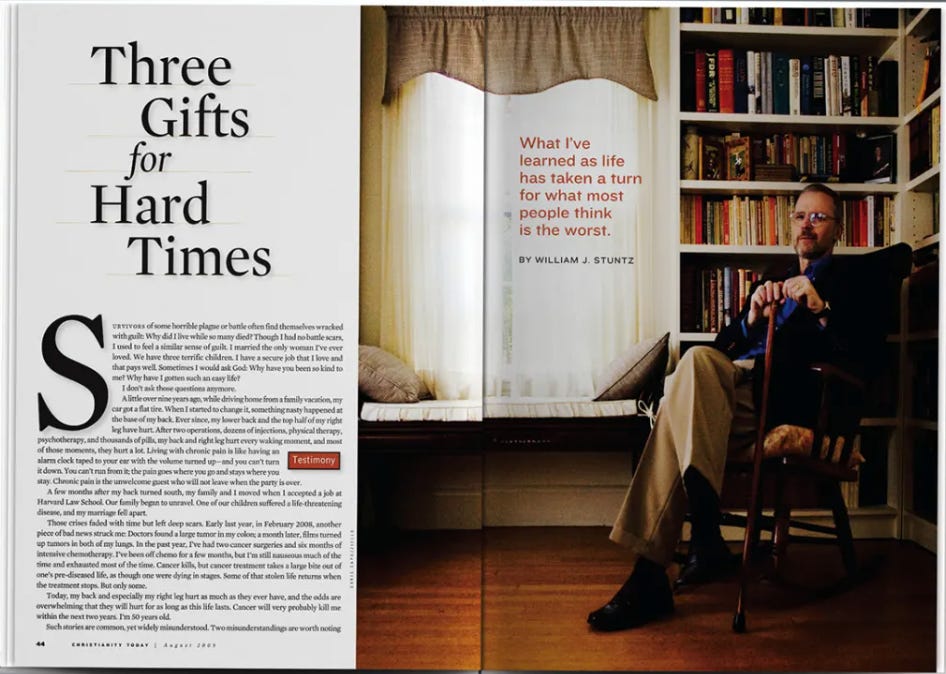
In any event, I got to thinking about Bill this week when I ran across an essay Bill wrote reviewing Christian Perspectives on Legal Thought (Yale University Press 2001) (AMAZON LINK), to which I contributed an essay on law and economics. Bill observed that:
Christianizing the legal profession might have a much larger effect on law practice than on law. To see why, consider Jesus’s occupation for most of his adult life: he made tables, or whatever it was that ancient Middle Eastern carpenters made.
Were the tables he made distinctive? Did he use different wood or a different manufacturing process than other carpenters used? The likely answer is no—at least, the gospel accounts offer no reason to think otherwise.
Now change the question: focus less on the noun and more on the verb. Instead of asking whether Jesus’s tables were different, ask whether he made the tables differently—whether his motivations and attitudes toward his work, the ways he treated his customers and his coworker, differed from the practices of other carpenters. The answer to that question is surely yes. (19)1
Reading that essay called to mind Gaudium et spes (literally “joy and hope,” but formally referred to as The Pastoral Constitution on the Church in the Modern World), one of the key documents to emerge from Vatican II. In it, the Council write:
They are mistaken who, knowing that we have here no abiding city but seek one which is to come, think that they may therefore shirk their earthly responsibilities. For they are forgetting that by the faith itself they are more obliged than ever to measure up to these duties, each according to his proper vocation. Nor, on the contrary, are they any less wide of the mark who think that religion consists in acts of worship alone and in the discharge of certain moral obligations, and who imagine they can plunge themselves into earthly affairs in such a way as to imply that these are altogether divorced from the religious life. This split between the faith which many profess and their daily lives deserves to be counted among the more serious errors of our age. Long since, the Prophets of the Old Testament fought vehemently against this scandal and even more so did Jesus Christ Himself in the New Testament threaten it with grave punishments. Therefore, let there be no false opposition between professional and social activities on the one part, and religious life on the other. The Christian who neglects his temporal duties, neglects his duties toward his neighbor and even God, and jeopardizes his eternal salvation. Christians should rather rejoice that, following the example of Christ Who worked as an artisan, they are free to give proper exercise to all their earthly activities and to their humane, domestic, professional, social and technical enterprises by gathering them into one vital synthesis with religious values, under whose supreme direction all things are harmonized unto God’s glory.
Secular duties and activities belong properly although not exclusively to laymen. Therefore acting as citizens in the world, whether individually or socially, they will keep the laws proper to each discipline, and labor to equip themselves with a genuine expertise in their various fields. They will gladly work with men seeking the same goals. Acknowledging the demands of faith and endowed with its force, they will unhesitatingly devise new enterprises, where they are appropriate, and put them into action. Laymen should also know that it is generally the function of their well-formed Christian conscience to see that the divine law is inscribed in the life of the earthly city; from priests they may look for spiritual light and nourishment. Let the layman not imagine that his pastors are always such experts, that to every problem which arises, however complicated, they can readily give him a concrete solution, or even that such is their mission. Rather, enlightened by Christian wisdom and giving close attention to the teaching authority of the Church, let the layman take on his own distinctive role.
I wonder what Bill would make of that passage. I think he would agree with much of it. Bill frequently made use of the example of Jesus’ work as a carpenter is discussing the vocation of the Christian lawyer and law professor. At one of the Christian law professor fellowship conferences, for example, I heard him say that Jesus doubtless took pleasure and an appropriate amount of pride in his work as a carpenter. He thought Jesus undoubtedly strived to master his vocation. Bill thus would certainly have agreed with the argument that we “should rather rejoice that, following the example of Christ Who worked as an artisan, [we] are free to give proper exercise to all their earthly activities and to [our] humane, domestic, professional, social and technical enterprises.”
I wonder, however, if Bill would have agreed with the statement that “it is generally the function of [the laity’s] well-formed Christian conscience to see that the divine law is inscribed in the life of the earthly city.” To no profession is the Church here speaking more directly that to our profession as lawyers and legal academics. Yet, as I read Bill’s work, I suspect he likely would be somewhat skeptical about the Church’s statement:
People fear the claim that right answers exist—that God is God, that he is sovereign, that Christ’s ownership of all time and space is total. Those are strong claims, and they are not readily susceptible to secular argument. The fear makes sense, though, only if another claim follows: that the speaker knows—really knows—what all the right answers are. The second claim does not follow from the first. The proposition that God’s agenda governs (the idea for which Scalia was castigated) does not entail the proposition that Christians know what that agenda is. Indeed, for Christians the real implication is nearly the opposite. My conclusions are suspect because the reasoning that produces them is tainted by my sin. My faith makes me less confident about my views, legal and otherwise, not more so. (25)
Bill and David Skeel refined those ideas in their article Christianity and the (Modest) Rule of Law.2 In it, they contended that there are “two kinds of law: one for hearts and minds, and the other for code books and courtrooms. Only God's law is fit for the former purpose. Law that operates in the latter territories must have more humble ambitions.” (812) As John Breen explains:
Arguing from an Evangelical perspective, they contend that the law is ill-suited to address a number of social ills to which it is frequently directed, including, conspicuously, the problem of abortion. They criticize the practice of enacting merely symbolic laws, a vice they term “legal moralism.” Because these sorts of laws are seldom enforced, they cannot teach the public the values that they purportedly embody. Moreover, because these laws often take the form of extensive moral codes, they undermine the rule of law as a whole by vesting an inordinate amount of discretion in the hands of public officials.3
So, I assume Bill would have doubts about the extent to which we can discern “the divine law” well enough to inscribe it into positive human law. And I am confident that he would argue that, even if we could do so, immorality and illegality are not coextensive:
So the positive law can forbid only a small fraction of what the moral law forbids, if the moral law is seen in Christian terms. Jesus made this clear by defining murder as anger and adultery as lust. A decent society could aspire to punish all murder, but all anger? Perhaps, in some imaginable society (though certainly not ours), law enforcers could punish adultery while avoiding selective prosecution. But not lust. (39)
...
The point is not that morals and law don’t mix. They plainly do. Rather, the point is that when morals are contested—when the populace is divided about the relevant rights and wrongs—the side that gets its hands on the law’s weapons often finds that those weapons backfire. Backlashes against this kind of legal moralism are not the exception in American history. They are the rule. That pattern suggests that moralists should usually target the culture instead of the law. (42)
...
Law may sometimes be an effective moral teacher, though I confess to having some doubts; I suspect that law follows the culture, not the other way around. Even if I am wrong, law surely teaches best when the relevant legal norms are enforced across the board, and when the moral precepts on which those legal norms rest are widely shared. In the spheres conservative Christians tend to emphasize most—reproduction, sexuality, physician-assisted suicide—the relevant morals are not widely shared. Where that is so, agnosticism—a poor moral stance, but often a wise legal posture—may be the law’s best option. (43)
I wonder whether there is something inherently Protestant about Bill’s approach to the question. (Bill was an evangelical who attended Park Street Church in Boston, a large and historic Congregational church.) I ask that because Gaudium et spes rather clearly thinks that there is a discernible Christian view, if not always an immediately obvious Christian solution.4
Note, for example, Bill’s suggestion that “law follows the culture, not the other way around.” As John Breen observes, “the Second Vatican Council made ‘culture’ a center point of the Council’s Pastoral Constitution on the Church in the Modern World, Gaudium et Spes.” (338-39) According to Breen, moreover, John Paul’s thought likewise gives priority to culture over law: “legal doctrines and institutions … come into existence and are sustained in the legal and political order because of some set of antecedent values that subsists in the culture.” (347)
As Breen demonstrates, however, Catholic social thought does not teach that law should always be modest and/or agnostic. “John Paul recognized the ‘sometimes decisive role’ that law plays ‘in influencing patterns of thought and behaviour.’” (372) “John Paul knew that law had a crucial role to play in combating the ‘structures of sin’ and securing the dignity of every human being.” (373)
When in doubt, my rule is to go with JPII. Even vis-à-vis a Harvard man.
At the end of the day, however, I’m just a little ol’ country corporate lawyer. This sort of stuff is mostly argued at levels above my pay grade.
But even so, I wish Bill was alive so I could pursue this with him.
William J. Stuntz, Christian Legal Theory, 116 Harv. L. Rev. 1707 (2003).
David A. Skeel, Jr. & William J. Stuntz, Christianity and the (Modest) Rule of Law, 8 U. Pa. J. Const. L. 809 (2006).
John M. Breen, John Paul II, the Structures of Sin and the Limits of Law, 52 St. Louis U. L.J. 317, 322–23 (2008).
Breen argues that Skeel and Stuntz’s evangelical perspective would have benefited from engagement with Catholic social teaching, especially the magisterium of Saint Pope John Paul II. 52 St. Louis U. L.J. at 323.
I wonder if the Christian law prof fellowship still meets off site during the AALS…