

The WSJ reported today that:
Two lower courts have ruled that Trump exceeded his authority when he tore down the East Wing of the White House in a matter of days last fall and immediately began construction on the ballroom without the approval of Congress. But he has been allowed to keep building while his administration pursued appeals.
In an emergency appeal to the Supreme Court last week, Trump asked the justices to let work continue on what the president now says is an integrated “military complex.” A preservationist group that is challenging it urged the justices to stop the project now, no matter that it is partially built.
FYI
The preservationist group in question is the National Trust for Historic Preservation, a nonprofit chartered by Congress.
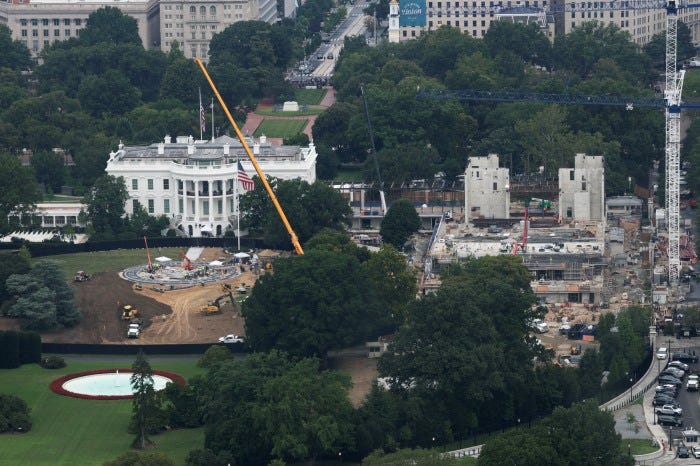
On Friday, Chief Justice John Roberts issued a one sentence order staying the lower court injunctions.
The effect of which is that construction will continue, as the WSJ explained, so that “a 250-person construction crew [that] has been working nearly around the clock to erect what the administration says is a ‘concrete-and-steel superstructure’ that is impermeable and virtually impossible to deconstruct now” can keep working.
The net result is that the new monstrosity likely will be completed before the legality of the project can be determined, which will present the courts with a fait accompli.
Classic Trump.
Barr’s Points
Also in the latest WSJ is an op-ed on the ballroom project by former Trump AG William Barr. He makes some interesting points. But ultimately not persuasive ones.
The Ballroom is Necessary
The White House urgently needs security upgrades to defend against modern threats like drone attacks, missiles, high-powered weapons and cyberattacks. It also requires a more secure and capacious ballroom for official events.
Plausible.
The real bone of contention is the opponents’ objection to the project’s aesthetics.
Probably true, but can you blame them? Trump’s aesthetic sense is gaudy and tasteless.
The Plaintiff Lacks Standing
In this case, the National Trust, a private nonprofit organization, plainly lacks the standing mandated by the Constitution. To have standing, an organization like the trust must show that (1) it has members who have suffered a concrete injury sufficient to have standing in their own right, and (2) that the interest the members seek to vindicate is germane to the organization’s purpose. Here, the lower courts found that the trust had standing based solely on the fact that a single member who claims to walk near the White House about once a month expects to dislike the design of the new East Wing.
That does sound like a pretty bogus basis for standing. In a dissent from the DC Circuit’s order upholding the lower court injunction, Judge Neomi Rao likewise concluded that the National Trust lacked standing, explaining that:
As an association, the Trust must show that “(1) its members would otherwise have standing to sue in their own right; (2) the interests it seeks to protect are germane to [its] purpose; and (3) neither the claim asserted nor the relief requested requires the participation of individual members in the lawsuit.” …
… as a congressionally chartered nonprofit, the Trust “is required to pursue ... goals defined by statute.” Congress established the Trust to serve four defined purposes: (1) receiving donations of historic sites, buildings, and objects; (2) preserving and administering those sites, buildings, and objects; (3) accepting and administering gifts to carry out its preservation efforts; and (4) executing other statutory functions.1
She concluded that “are germane to a lawsuit challenging the building of a ballroom and updated security facilities on White House grounds.”
But while I’m not an expert on standing, I did find a 1988 Illinois supreme court decision holding that:
We have closely examined the functions vested in the National Trust, and we agree that Congress intended the National Trust’s functions to be extremely broad. …
The National Trust was thus created in part to … “to preserve for public use historic sites, buildings, and objects of national significance for the inspiration and benefit of the people of the United States.” … It appears to us that in bestowing powers on the National Trust in order to further this broad national policy, Congress intended to permit the National Trust to, inter alia, object to the allegedly unlawful destruction of buildings such as the McCarthy Building, which the National Trust deems of national historic significance, even if those buildings have not been officially declared “national landmarks.”It seems essential that, in order to perform its congressionally mandated functions, the National Trust must be allowed to maintain suits in State courts to prevent unlawful destruction of buildings it deems of national historic significance. …
We thus conclude that Congress intended the National Trust to have standing to maintain actions such as this, and that such standing is necessary if the National Trust is to fulfill the functions Congress intended it to fulfill.2
On the other hand, a Virginia decision in which the National trust sought to protect the Wilderness Battlefield held that:
… the National Trust has no direct, specific interest in the Wilderness Battlefield property and no pecuniary or financial obligations that will be directly affected by the issuance of the SUP. Therefore, to find that standing has been established here would essentially mean that the National Trust has standing in any case where it unilaterally decides that it must participate in litigation to preserve or protect some historic or public interest in federal property. On this point, Mr. Rosenbaum conceded at oral argument that to prevail on this issue, the court would almost have to accept an “automatic standing” rule for the National Trust. The court respectfully declines to do this because it can find no decided case in which this rationale was successfully applied.3
Suffice it to say, perhaps, that the standing question is not as straightforward as Barr would have his readers believe. Which is hardly surprising:
“the doctrine of standing is a convoluted and sometimes misunderstood doctrine”4
“standing is one of the more convoluted doctrines in effect throughout the federal judiciary and simply cannot be explained in terms of concise requirements”5
Trump Acted Lawfully
President Trump has a solid legal and historical basis to rebuild the East Wing. There is a long history of presidents engaging in construction and renovation projects on the White House and its grounds. In 1942, for example, Franklin D. Roosevelt tore down most of the East Wing and rebuilt it from the ground up. Since FDR’s project, Congress passed a law recognizing that the president has authority to alter and improve the White House. It is under that authority, and consistent with the long sweep of history, that the president constructs the ballroom.
This strikes me as a perfectly plausible legal argument. But the question remains: who decides?
The Judicial Province and Duty
Barr followed that argument with this observation:
Moreover, the remedy called for here isn’t suitable for judicial administration. It would task a federal judge with deciding what is required for the president’s security. But federal judges are ill-suited to make these decisions or serve the role of chief architect and foreman over complex construction projects.
Which is certainly true. But also disingenuous.
The question is not whether the design of the new ballroom wing is attractive, beautiful, or architecturally appropriate.
The question is whether Trump had legal authority to unilaterally start demolishing the old East Wing and building a new one.
And that is a question for the courts:
It is emphatically the province and duty of the judicial department to say what the law is. … If two laws conflict with each other, the courts must decide on the operation of each.6

The Supreme Court Should Not Allow Trump to Create a Fait Accompli
Chief Justice Robert’s decision was a mistake. It will allow Trump to create facts on the ground—a fait accompli—that will be difficult, costly, and highly controversial to reverse.
Preventing such fait accomplis is precisely the purpose of the sort of injunctions the lower courts granted.
In City of Del City v. Harris,7 for example, the Oklahoma Supreme Court declined to grant a stay of an injunction pending an appeal, precisely to avoid allowing the party seeking the stay to “create a fait accompli by the time the appeal could be determined” and thus rendering the issues on appeal moot.
In the labor context, where “a party to a labor dispute seeks to maintain the status quo pending arbitration, of paramount concern is whether denial of an injunction would frustrate the purposes of arbitration by presenting the arbitrator with a ‘fait accompli.’”8 The same should be true of the stay of an injunction.
Conclusion
At his confirmation hearing, Chief Justice Roberts said it was jis job to call the balls and strikes.
In this case, Roberts failed to do his job.
Instead, he created a situation in which Trump can stroll around the bases, touch home plate, declare a touchdown, have the scoreboard record it, and then dare Roberts to undo the fait accompli.
Natl. Tr. for Historic Preservation in the U.S. v. Natl. Park Serv., No. 26-5101, 2026 WL 980554, at *5 (D.C. Cir. Apr. 11, 2026) (Rao, J., dissenting).
Landmarks Preservation Council of Illinois v. City of Chicago, 531 N.E.2d 9, 14 (Ill. 1988). See also Landmarks Illinois v. Rock Island Cnty. Bd., 162 N.E.3d 373, 389 (Ill. App. 3d Dist. 2020) (holding that “the National Trust for Historic Preservation (National Trust), a congressionally chartered not-for-profit corporation, has standing to challenge the defendants’ demolition of the courthouse pursuant to the federal Historic Sites, Buildings, and Antiquities Act”).
Natl. Tr. for Historic Preservation in U.S. v. Bd. of Supervisors of Orange Cnty., 80 Va. Cir. 321 (Va. Cir. 2010).
Moore U.S.A., Inc. v. Stand. Register Co., 180 F. Supp. 2d 411, 412 (W.D.N.Y. 2001).
Jordan v. U.S., 863 F. Supp. 270, 272 (E.D.N.C. 1994).
Marbury v. Madison, 5 U.S. 137, 177 (1803).
508 P.2d 264 (Ok. 1973).
Elec. Contractors’ Ass’n of City of Chicago, Inc. v. Loc. Union No. 134, Intern. Broth. of Elec. Workers, No. 94 C 0336, 1994 WL 27878, at *1 (N.D. Ill. Jan. 31, 1994). See also New York State Nurses Assn. v. Brooklyn Hosp. Ctr., No. 26-CV-745(EK)(PCG), 2026 WL 414520, at *1 (E.D.N.Y. Feb. 14, 2026) (“The Second Circuit has given the example of ‘a company’s plan to sell a division, [which,] if not enjoined, would render the [arbitration] process meaningless by presenting an arbitrator with a fait accompli.’”).