

I used to joke that I’d like to end my career as a corporate lawyer and academic as a member of the Delaware Chancery Court. It’d be like playing for the Yankees in their prime. The most important court in the most important area of the law. And so I would post a note every time there was a vacancy that got filled with somebody else about how unfair it is that you have to live in Delaware to even be considered.
When the most recent vacancy was filled, I filed the obligatory “passed over again” comment on LinkedIn. But I noted that the Securities and Exchange Commission is down to just two members. Three vacancies need filling. So, I posited that maybe I should switch my aspirations to ending my career as an SEC Commissioners.
And then I thought ….

I spent most of my first 30 years living in the DC area. My oldest friend lives there.
Granted, SEC chairs historically have treated their fellow Commissioners like mushrooms.1 But at my age it’d be a sinecure.
But there’s a problem.
The Problem’s Backstory
I first was eligible to vote in 1980. I was not then particularly committed to either political party, but I hated Jimmy Carter with a passion. I now realize that he was basically a good guy who was hopelessly unsuited to being President. But in 1980 I firmly believed he didn’t deserve 4 more minutes in the White House let alone 4 more years. But Ronald Reagan seemed … well, scary. I ended up working for the John Anderson campaign. First of many times my candidate would lose.
My politics wobbled over the next few years, but sometime around 1985 I read Russell Kirk’s magnum opus, The Conservative Mind (Amazon Link). It was a life-changing epiphany. A Road to Damascus moment.
In 1988, I got my first law teaching job and started hanging out with progressive academics. I quickly decided I liked them as people but their politics were just nuts. Living in that environment pushed me the rest of the way into being a Reagan Republican.
True Confession
I actually became and remain a huge Reagan admirer. But, sadly, not in time to actually vote for him.
Worse yet, however, I must confess that for many years I engaged in revisionist history in which I implied that I had voted for Reagan. Both times. Mea culpa.
There used to be Democrats I admired. Sam Nunn. Scoop Jackson. Joe Lieberman. Chuck Robb. Even Bill Clinton had his moments, at least when he wasn’t dipping his cigar into places it should not have gone.
But now you’ve got shrill liberal paternalists like Hillary Clinton and Elizabeth Warren.
You’ve got empty suits who use too much hair spray like Gavin Newsom.
And now you’ve got the Woke. Woke 1. Woke 2. Spare me.
Hating the Democrats
The Democrats Are Ruining California
Democrats have had majorities and sometimes supermajorities in the California Assembly every year since 1996. They’ve had majorities and sometimes supermajorities in the California Senate since the 1970s. They’ve held the Governor’s mansion since 2011.
And what has been the result?
If California were an independent country, we’d have the fourth or fifth largest economy in the world. Our business community has managed to do that despite California having just the 17th best climate for business according to CNBC. And the 50th in a CEO survey.
California gets failing marks in multiple key categories: “Business friendliness (F), Cost of doing business (D-), Quality of life (C), and Cost of Living (F) – all factors when business owners consider opening a business, expanding a business, moving a business, or even continuing to stay in business.”
California ranks 48th overall on the Tax Foundation's State Tax Competitiveness Index, meaning it has one of the least competitive and highest-taxed tax structures in the United States.
California regular gasoline averages about $6.38 per gallon, which is roughly $2.00 higher than the U.S. national average of around $4.40 per gallon, according to AAA. We have higher fuel prices than Hawaii.
California experiences ongoing net domestic out-migration, with thousands more residents moving to other U.S. states than arriving from them each year, according to data from the Public Policy Institute of California.
Great weather can only trump lousy governance for so long.
Policies
There are multiple places where I strongly disagree with core and/or emerging Democratic policies: abortion, religious freedom, taxes, spending, national defense, Supreme Court packing, healthcare, education, voter ID, immigration, Israel, gun control, and the list goes on and on. The first six are all deal breakers.
Liz Warren
Here’s where my ambition (such as it is) to be an SEC Commissioner really hits a brick wall. SEC nomination go through the Senate Banking Committee, where Elizabeth Warren serves as ranking member (and could easily become chair after the mid-terms).
My X feed and the archives of my old ProfessorBainbridge.com blog are loaded with criticisms of Warren. Over the years, I have disagreed with Warren about her proposals that:
U.S. companies with over $1 billion in annual revenue must obtain a federal corporate charter rather than relying solely on state incorporation.
Corporate directors must legally consider the interests of all stakeholders, including employees, communities, and the environment, alongside shareholders.
At least 40% of the board of directors must be elected directly by the company's workforce.
Corporate political expenditures require a 75% supermajority approval from both shareholders and directors.
Limiting stock buybacks.
Vigorously disagreed.
Which would not bode well for my confirmation hearing.
Hating the Republicans
I am somewhat ashamed to admit it, but back in 2016 I actually supported Donald Trump. I wrote a blog post explaining why. The core of my argument was that Trump seemed to personify a necessary response to what Christopher Lasch called The Revolt of the Elites (AMAZON LINK). So, when Trump won in 2016, I must confess to feeling a good deal of schadenfreude, especially as I watched the pointy heads on campus blowing up.
But I was wrong.

Top 10 Trump Misfeasances and Malfeasances
In no particular order:
January 6th coup attempt
Pardoning the insurrectionists
Massive corruption
Greenland
Tarriffs
Claiming he won in 2020 and seeking to overturn the result
Nixon really did get robbed in 1960 by Mayor Daley but for the good of the country he didn’t try to overturn the result
Cozying up to dictators while undermining the Western alliance.
The narcissism and meagalomania:
The Kennedy Center
The Arch
The East Wing
The Coin
etc…..
Starting new Middle Eastern wars when he promised not to
Militarizing immigration policy
Your list probably differs from mine. After all, there are so many to choose from. Plus, this is just off the top of my head.
Abandonment of Conservative Principles
Russell Kirk once set out 10 conservative principles. I believe in each and every one of them. I don’t think Trump or MAGA have ever heard of them and I don’t think their behavior is consistent with most.
First, the conservative believes that there exists an enduring moral order.
A society in which men and women are governed by belief in an enduring moral order, by a strong sense of right and wrong, by personal convictions about justice and honor, will be a good society—whatever political machinery it may utilize; while a society in which men and women are morally adrift, ignorant of norms, and intent chiefly upon gratification of appetites, will be a bad society—no matter how many people vote and no matter how liberal its formal constitution may be.
Under Trump, the Republicans have become “morally adrift, ignorant of norms, and intent chiefly upon gratification of appetites.”
Second, the conservative adheres to custom, convention, and continuity.
Constant change seems to be Trump’s modus operandi.
Third, conservatives believe in what may be called the principle of prescription.
Conservatives sense that modern people are dwarfs on the shoulders of giants, able to see farther than their ancestors only because of the great stature of those who have preceded us in time.
Trump thinks he is the giant.
Fourth, conservatives are guided by their principle of prudence.
Is there be a more imprudent person than Donald Trump?
Fifth, conservatives pay attention to the principle of variety.
Sixth, conservatives are chastened by their principle of imperfectability.
Trump seems to believe he has achieved perfection and that all must follow.
Seventh, conservatives are persuaded that freedom and property are closely linked.
Okay. Trump probably believes in this one. At least as far as his own freedom and property are concerned.
Eighth, conservatives uphold voluntary community, quite as they oppose involuntary collectivism.
Conservatives used to believe in things like federalism, sphere sovereignty, and subsidiarity. Trump is a centralizer.
Ninth, the conservative perceives the need for prudent restraints upon power and upon human passions.
Indulging his personal passions seems to be Trump’s chief preoccupation.
Tenth, the thinking conservative understands that permanence and change must be recognized and reconciled in a vigorous society.
Trump seems to believe in breaking stuff and moving fast.
A Republican Party that no longer embraces these principles cannot be called conservative.
Nor can such a party command my allegiance.
All of which means I can kiss the prospect of a Republican nomination to the SEC goodbye.
My Fellow Double Haters
It turns out I’m not alone.
The Wall Street Journal recently reported that:
More voters say they dislike both the Democratic and Republican parties than in other recent elections, the result of economic anxiety and deep dissatisfaction with politicians and government. Some 21% of the voter pool holds an unfavorable view of both parties, a recent Wall Street Journal poll found, significantly above the 13% in the 2022 midterms and about 12% in the past two presidential elections. …
These dissatisfied voters, often called “double haters,” have been a bellwether in the past, siding with the winning party. Currently, more than 40% of them are either undecided on their vote for Congress or not fully committed to either party, the Journal poll found. That leaves the two parties scouring for support among a distrustful group.
Of course, neither party will be scouring for my vote. I live in one of the bluest parts of one of the bluest states. I am surrounded by people who keep voting for Democrats despite what that party has done to our state.2 I haven’t voted for a winner in 30 years.
But that is neither here nor there.
Comparing Myself to my Fellow Double Haters
According to the Journal:
Just under two-thirds say politics is important to their personal identity, about the same share as among all voters in the Journal survey, and 57% said they voted in the last midterm, just under the 62% of all respondents. About 60% rate themselves at the highest level of motivation to vote this year, lower than the 76% among all respondents.
Ditto to all four.
Asked about the Democratic Party, the most frequent answer from double haters was “weak,” followed by “corrupt” and then “ineffective.” Asked about Republicans, the most frequent answer from double haters was “corrupt or dishonest,” followed by “ineffective.”
Ditto.
But let’s dig deeper:
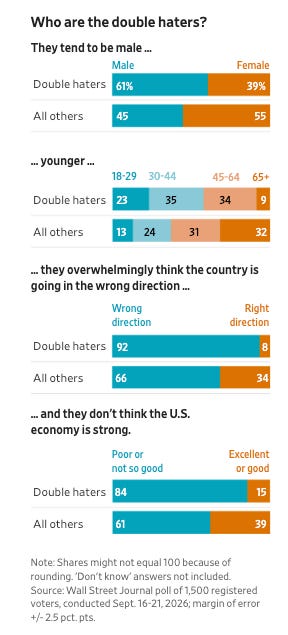
Male? Check.
Younger? No. What’s with my fellow boomers? How can they be so blind?
Wrong direction? Check.
Strength of the economy? Meh. My stock portfolio’s doing okay, but I’m paying almost 8 bucks a gallon for gas.
So What Do We Make of All This?
Most of you don’t pay anything for this Substack and you get the level of profundity for which you pay.3
But, for what it’s worth, my answer was to join the American Solidarity Party.
I don’t agree with everything the Party embraces (I’m skeptical of distributism, for example), but on issue after issue their positions map far more closely to mine than either of the duopoly parties.
A colleague of mine periodically castigates me for “wasting my vote” on a third party. On that issue, among others, I commend to your attention David McPherson’s A Case for the American Solidarity Party:
Another question for the ASP is this: Why should someone vote for a party that won’t win, especially in this election, when so much is at stake in terms of foreign relations, the economy, Supreme Court appointments, democratic rule of law, and so on? Isn’t it better to vote for the major-party candidate who seems the least bad?
Many people of goodwill are going to make this decision. But for those who cannot in good conscience vote for either Clinton or Trump—say, because of the candidates’ stances against the sanctity of human life—voting for the ASP may be seen as a protest vote against a system that presents us with such poor choices. But it is not merely a protest vote, because if we are to work fully toward the kind of politics we need, we must first break from the political status quo. The ASP should thus be understood as seeking primarily to build up a cultural movement, which ideally will come to have political influence.

Keep them in the dark and feed them manure.
Google tells me that:
Albert Einstein did not say, "Insanity is doing the same thing over and over again and expecting different results."
Whatever. He should have done so.
Just kidding. I love you all. But, seriously, tips are accepted.