

When I first started blogging back in 2003, one of my earliest posts mused on picking the right wine for Thanksgiving dinner. Two decades-plus later, my vintage recommendations may have changed, but my varietal choices have not.
Starting in the Right Place
The turkey may be the star of the show and the centerpiece of the table, but it is not what determines the choice of wine for Thanksgiving dinner.

All those powerful sweet flavors (yams with little marshmallows) competing with equally potent savory flavors (herbed stuffing) are what has to drive your choice.
After all, they are the problem children at the table on Thanksgiving. You have a lot of strong and diverse flavors with which to deal. Worse yet, you’ve got both sweet and savory items, sometimes in the very same dish: herbed stuffing, yams with those little marshmallows, cranberry in some form, and (lord help us) Jello molds.
The direction in which all of this drives you is towards a wine that is high acid with lots of fruit and moderate tannins. You need bright acidity to stand up to the rich and fatty parts of the meal. High tannins will taste harsh and bitter in the face of sweet glazes and side dishes.
“Experts” will give you lots of options: Off-dry Riesling. Pinot Noir. Rhone and Rhone-style blends. Beaujolais.
All fine wines.
The Right Choice
But, to my mind, there is just one choice at Thanksgiving: Zinfandel.
In the first place, while lots of countries have some sort of thanksgiving holiday, Thanksgiving—with a capital T—is a quintessentially American holiday. So I start narrowing down the field with a basic proposition: Only American wines on the Thanksgiving table.
Granted, I don’t push that point to its logical conclusion. Truly American wines from true North American grapes come from different species that European grape varieties. American grapes come from vitis labrusca (think Concord) or vitis aestivalis (Norton being the best known example, although it’s likely a hybrid). I am not a fan. Concord and other vitis labrusca varieties and hybrids have an off putting aroma and flavor that wine gurus refer to as foxy.
So, this points us towards vitis vinifera varieties, but with a uniquely American twist. And that points us to Zinfandel. True, Zinfandel originated in the Balkans—most likely Montenegro. But it virtually disappeared in Europe after the phylloxera epidemic.
Somehow, however, Zinfandel found its way to the United States—probably via a horticulturist named George Gibbs. Zinfandel’s rise truly began, however, when it was brought to California during the Gold Rush. It thrived here and soon became the most widely planted grape variety in California (although today it’s in third place behind Chardonnay and Cabernet Sauvignon). There are still 100-plus year old Zinfandel vines producing good wine in spots around the state.
In short, it has been aptly said that Zinfandel is the most distinctly American of all wine grapes—a variety that arrived as a lowly immigrant and became something magnificent.

In addition, to the chauvinistic argument for Zinfandel, it is also just a great choice.
Zinfandel’s spicy berry flavors and mellow tannins are going to match up to the classic Thanksgiving fare much better than would, say, the steely tannins and currant and cedar flavors of a good Cabernet Sauvignon.
If you’re using a good free range, heritage turkey, as you should, its dark meat in particular has plenty of flavor to stand up to a zinfandel.
If you want to show off the wine, roast turkey—like roast chicken—is an great blank canvas against which the wine will show brilliantly. Granted, turkey is not quite as much of a blank canvas as roast chicken, as it has stronger flavors and a firmer texture, but it still will work well with most wines.
But pushing the boat out too far is not something I do recommend for Thanksgiving. Assuming a gathering of friends but not of wine snobs, you want good wines that will complement the food but not be the star attraction. And, in any case, no fine claret or Burgundy should have to compete with little marshmallows. So, at the Thanksgiving table, I think the wine should be a condiment rather than the star, due to the presence of all those other dishes with their complicated flavors.
Which leads me back to Zinfandel and a Ridge Lytton Springs or Geyserville Zinfandel-based wine with some age on it has been my standard Thanksgiving wine for many years.
Back in 2020, for example, we went with a trio of 8 year old Ridge wines:
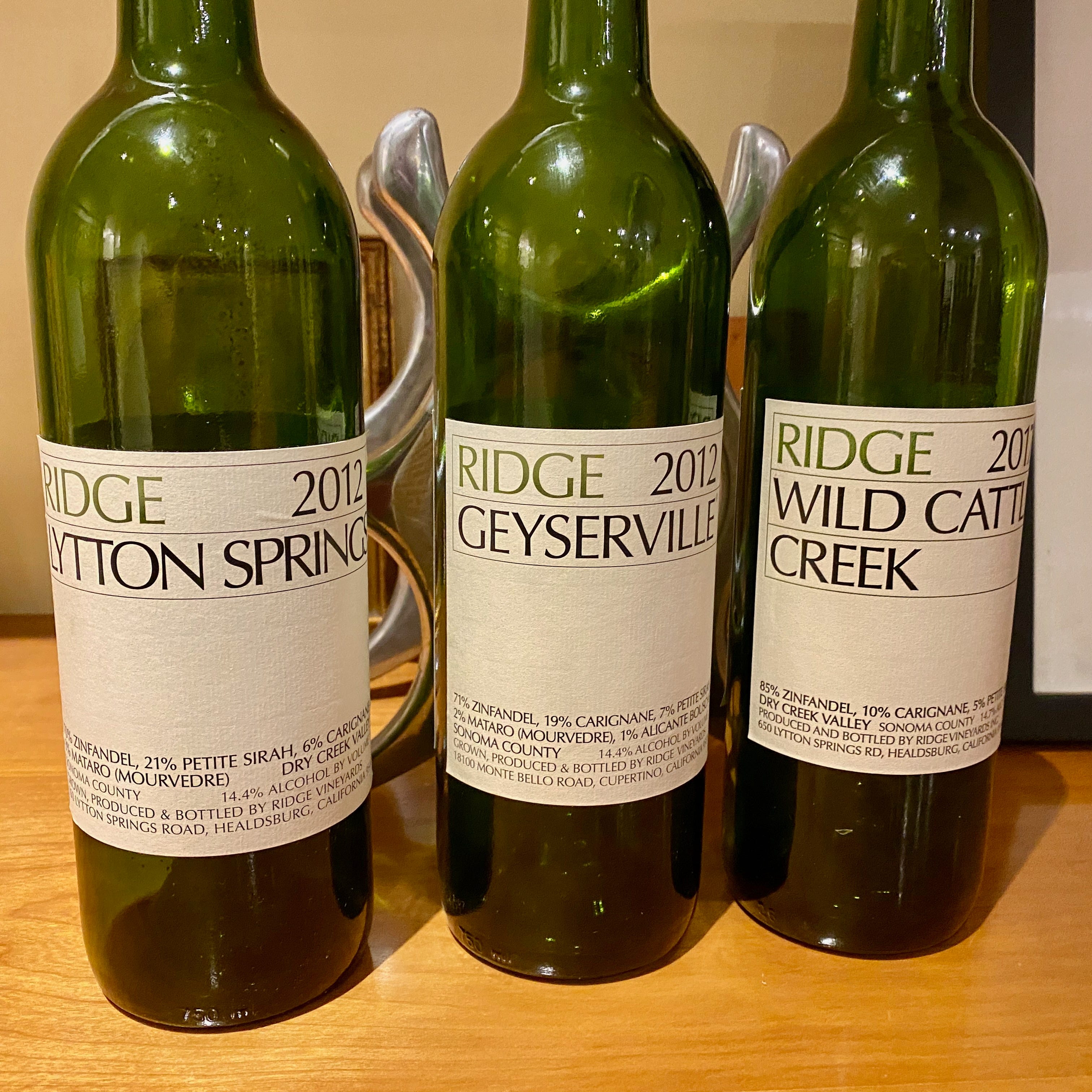
I’m biased in favor of Ridge, of course, since I’ve been a member of their wine clubs since 1990 or so. But other great options include: Bedrock Wine Co., Carlisle Winery, A. Rafanelli, Seghesio Family Vineyards, and Storybook Mountain Vineyards.
I’m a fan of Turley Wine Cellars, but their Zinfandels tend to be big, very high alcohol, tannic fruit bombs. Not a wine for my Thanksgiving table, where a lower volume wine is my preference. Granted, there are exceptions. Their Dragon Vineyard bottling, for example, is more in the “claret style” but better safe than sorry.