

Ken Adams is the author of A Manual of Style for Contract Drafting (AMAZON LINK), which IMHO is the single best guide for lawyers drafting contracts. His blog Adams on Contract Drafting has been on my “must read” list for years. He is the guru.
He’s got a new short article on a case—Treasure Coast Classical Academy, Inc. v. Optima Foundation, Inc.1—that turned on the placement of a comma. It should be of interest for any readers curious about legal writing, contracts, or just how punctuation works.
Here’s the key sentence from the contract at issue in the case the article is about:
State Governing Law/Venue/Waiver of Jury Trial. The rights of all parties hereto shall be subject to the jurisdiction of and be construed according to the laws of the State of Florida, with venue in Collier County, Florida.
The question was whether bringing suit over the contract in Collier County was mandatory or permissive. Ken explains:
Because the provision at issue in Treasure Coast includes a comma before the venue provision, the appellate court said that "the importance of the comma in the clause here cannot be understated." It held that "'shall' applies only to the choice of Florida law rather than to venue selection."
Ken then proceeds to demolish the court’s interpretation of the contract. Go read the whole thing.
Comma Law
I’m a big fan of commas. I tend to sprinkle them throughout my writing.
Not surprisingly, one of my chief bugaboos is the serial comma (a.k.a. the Oxford comma).
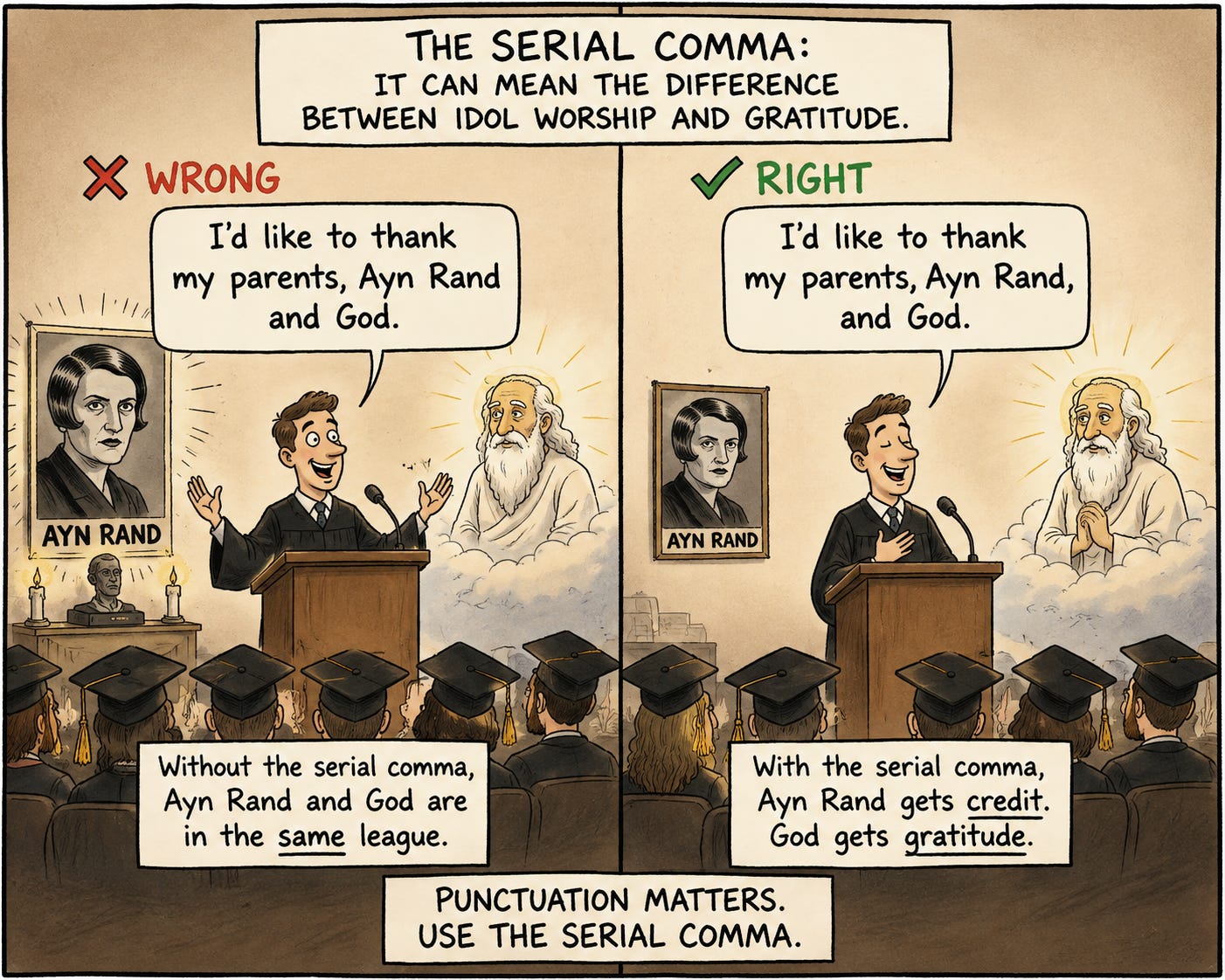
My former colleague Eugene Volokh (of The Volokh Conspiracy fame) recently wrote a post, Punctuation Matters. At the Heart of This Case Is the Placement of a Comma, focusing on a case in which the issue was whether Remus Enterprises 1, LLC or Remus Enterprises, 1 LLC was the owner of a parcel of real property in Washington, D.C. The court explained that:
a consent judgment in another case established that a different entity with a name containing all the same words and letters but a differently placed comma—Remus Enterprises, 1 LLC ("Remus 2018")—was the real owner of the property.
The Serial Comma and the Law
Back in 2017 Eugene wrote a post, ‘A, B or C’ vs. ‘A, B, or C’ -- the serial comma and the law, focusing on “a dispute between a Maine dairy company and its delivery drivers” concerning “the scope of an exemption from Maine's overtime law.” Eugene explained:
The Maine overtime law excludes employees that are involved in “the canning, processing, preserving, freezing, drying, marketing, storing, packing for shipment or distribution of” various perishable products. The question - should this be read as employees involved in
(a) canning, (b) processing, (c) preserving, (d) freezing, (e) drying, (f) marketing, (g) storing, (h) packing for shipment, or (i) distribution of those products - a broad interpretation, favored by the employer - or
(a) canning, (b) processing, (c) preserving, (d) freezing, (e) drying, (f) marketing, (g) storing, or (h) packing for shipment or distribution of those products - a narrow interpretation, favored by the employee drivers.
The court concluded that the provision was ambiguous ….
Maine’s official legislative drafting manual advised drafters of statutes against the use of the serial comma, which suggests that option # 2 was the correct one. But, the court observed, the statute included a single conjunction, which suggested that option # 1 was correct. Given that ambiguity and Maine case law suggesting that ambiguities should be resolved in favor of the drivers, the court opted for # 2. It concluded:
We would be remiss not to note the clarifying virtues of serial commas that other jurisdictions recognize. In fact, guidance on legislative drafting in most other states and in the Congress appears to differ from Maine's when it comes to serial commas. Some state legislative drafting manuals expressly warn that the absence of serial commas can create ambiguity concerning the last item in a list.
Delaware Law
As a corporate law guy, my chief interest is what Delaware courts do. In Daniel v. Hawkins,2 the Delaware Supreme Court explained that:
The rule of the last antecedent is a canon of construction which provides that:
“Referential and qualifying words and phrases, where no contrary intention appears, refer solely to the last antecedent. The last antecedent is the last word, phrase, or clause that can be made an antecedent without impairing the meaning of the sentence. Thus a proviso usually applies to the provision or clause immediately preceding it. A qualifying phrase separated from antecedents by a comma is evidence that the qualifier is supposed to apply to all the antecedents instead of only to the immediately preceding one.”
On the other hand, the Delaware Chancery Court has explained that:
A court applying Delaware law “will not allow the imprecise placement of adverbs and commas to alter the otherwise plain meaning of a contractual provision or to frustrate the overall plan or scheme memorialized in the parties’ contract.” Interim Healthcare, Inc. v. Spherion Corp., 884 A.2d 513, 556 (Del. Super.), aff’d, 886 A.2d 1278 (Del. 2005) (ORDER) ….3
Miscellany
According to Westlaw, there are 155 law review articles that reference the “Oxford comma.” In contrast, there are 161 that refer to the “serial comma.” National chauvinism at work?
No. 4D2025-1577, 2026 WL 2104076 (Fla. Dist. Ct. App. July 22, 2026).
289 A.3d 631, 662 n. 56 (Del. 2023).
Symbiont.io, Inc. v. Ipreo Holdings, LLC, No. CV 2019-0407-JTL, 2021 WL 3575709, at *35 (Del. Ch. Aug. 13, 2021).