

This summer I’ve been rereading Father Berard L. Marthaler’s wonderful book, The Creed: The Apostolic Faith in Contemporary Theology (AMAZON LINK), which offers a comprehensive study of the Apostles’ and the Nicene Creeds, which are the Christian Church’s foundational statements of belief. I’ve been cross-referencing Bishop Robert Barron’s study of the Nicene Creed, Light from Light (AMAZON LINK), which is a little more dense.
In this post, I’m focusing on the portion of the Apostle’s Creed that reads:
He descended into hell; the third day He arose again from the dead. He ascended into heaven, and sits at the right hand of God, the Father Almighty.

The corresponding portion of the Nicene Creed reads:
For our sake he was crucified under Pontius Pilate, he suffered death and was buried, and rose again on the third day in accordance with the Scriptures. He ascended into heaven and is seated at the right hand of the Father.
As the Catechism explains (§ 512):
Concerning Christ’s life the Creed speaks only about the mysteries of the Incarnation (conception and birth) and Paschal mystery (passion, crucifixion, death, burial, descent into hell, resurrection and ascension).
And it further explains that it is through “the great Paschal mystery—his death on the cross and his Resurrection—[that Jesus] would accomplish the coming of his kingdom.”
What is the Paschal mystery?
The word Paschal comes from the Greek word pascha, which in turn came from the Hebrew word pesah (or pesach) and the Arabic word pascha, is usually translated as “passover.” In using the term Paschal mystery to describe Christ’s salvific sacrifice, the Church asserts that the preservation of the Israelites at the first Passover was a foreshadowing of the salvation to be offered all by Christ Jesus. Christ was the perfect sacrificial lamb foreshadowed by the lambs sacrificed by the Israelites at Passover, as Justin Martyr explained:
“The mystery, then, of the lamb which God enjoined to be sacrificed as the passover, was a type of Christ; with whose blood, in proportion to their faith in Him, they anoint their houses, i.e., themselves, who believe on Him. Justin Martyr Dialogue with Trypho Chapter XL
The word mystery also requires explication. Catholicism is not a Gnostic religion in which only believers have access to secret knowledge. When the Church refers to a mystery, it is talking about a revealed truth that we cannot fully understand or prove by human reasoning alone.
The Four Parts
The Paschal mystery has four key parts:
The Passion: Jesus’ suffering in the Garden of Gethsemane and his subsequent trial and crucifixion.
The Death: Jesus’ ultimate sacrifice on the cross to bridge the gap between humanity and God, conquering the power of sin.
The Resurrection: Christ’s triumph over the grave, offering humanity the hope of eternal life and proving that love and grace conquer death.
The Ascension: Jesus’ return to heaven in his glorified body, opening the gates for all people.
The Emergence of the Term
The Constitution of the Sacred Liturgy, one of the key documents of Vatican II, put the Paschal mystery at the heart of the liturgy, recognizing the emphasis laid on it during the liturgical reforms of the last century:
… for well-disposed members of the faithful, the liturgy of the sacraments and sacramentals sanctifies almost every event in their lives; they are given access to the stream of divine grace which flows from the paschal mystery of the passion, death, the resurrection of Christ, the font from which all sacraments and sacramentals draw their power.
But the term is not entirely new, as Father Daniel Eusterman explains:
Though the term “Paschal Mystery” was not widely known 100 years ago, the content of this term is not altogether novel to the history of the Church. Rather, by magisterially adopting aspects of the theology from the Liturgical Movement, the Church has recovered an ancient understanding of what is today named the Paschal Mystery.
The earliest known use of the phrase Mysterium Paschale goes back to a bishop of the second century, Melito of Sardis, who, like many of the Fathers, examined the life and death of Christ in light of the Old Testament types. Melito recognized in the life and death of Jesus the final and eternal fulfillment of the sacrifice of the Jewish Passover lamb.
The Paschal Mystery in the Liturgy
The centrality of the Paschal mystery to the post-Vatican II liturgy is suggested by the Catechism’s reference (art. 3.VI) to the Mass as “the Paschal Banquet.” In doing so, it reflects the Constitution of the Sacred Liturgy, which stated that “the Church celebrates the paschal mystery every eighth day; with good reason this, then, bears the name of the Lord's day or Sunday.” (§ 106)
Accordingly, as Kately Javier explains:
At every Eucharist, the drama of redemption is made present anew as Christ offers his Body for the salvation of the world. The Paschal Mystery by which our redemption is accomplished is re-presented on the altar. … Christ commanded that we celebrate the Mass as an act of remembrance of the Paschal Mystery he was to undergo and by which he reconciled us with God the Father.
… At the Eucharistic celebration, the Paschal Mystery breaks through the limits of time, space, and even human reason as we are made present to the moments in which Christ suffers, dies, rises from the dead, and ascends into heaven.
Although we encounter the Paschal Mystery every Sunday in the Mass, the Easter Triduum is unique. Indeed, Easter is what Marthaler calls “the principal celebration of the Paschal mystery.”
As Father Eusterman notes:
Though the reality of the Paschal Mystery is present and accessible in all of the liturgies of the Church, it is during the celebrations of the Sacred Triduum in which the lines seem to fade away between our own personal histories and Christ’s saving event, fulfilled in history. The liturgies of Holy Week display the Paschal Mystery in word and gesture most explicitly. From Genesis to Jesus, the scriptural narrative invites us to walk (and even fall down) with Christ. Holy Thursday marks the free handing over of the Son as he institutes the saving Eucharist and Priesthood for sacrifice and service. Good Friday sets our own suffering on the redemptive way of the Cross, to witness the central act of self-gift of the God-Man in his Passion and death. Then, at the Vigil, with the Paschal Candle aflame and darkness in flight, the announcement of our glorious salvation in Jesus’ victory rings out: “This is the night, when Christ broke the prison-bars of death and rose victorious from the underworld.”
These liturgies invite us, with St. Paul, the Church Fathers, and every century of the Church’s celebration, to actively participate in the reality of the Paschal Mystery made present and tangible within the Holy Mass.
A Note on the “Facticity” of the Death
By the by, Bishop Barron writes of the Death that:
Over the centuries, there have been fanciful attempts to show that Jesus did not die on the cross but swooned, only to be revived later. That a dreadfully wounded man, staggering half-dead out of his tomb, would ever be mistaken for the risen Lord is, of course, beyond ludicrous. The Romans were skilled executioners, and if there were any doubt that the cross had done its terrible work, the lance-thrust into the heart of Jesus should have eliminated it. It is interesting to note that the Gospels themselves and numerous summary statements of the Paschal Mystery throughout the New Testament make special reference to the burial of the Lord, presumably to hammer home the facticity of his death.
… Balthasar … means that the downward trajectory of the Incarnation reaches its limit here, in the tomb of Jesus, when the Son of God enters into the experience of having no experience, into the negation, the nonbeing, of death. Having hit rock-bottom, the Son of God finds solidarity with all those human beings who have come to that same awful place.
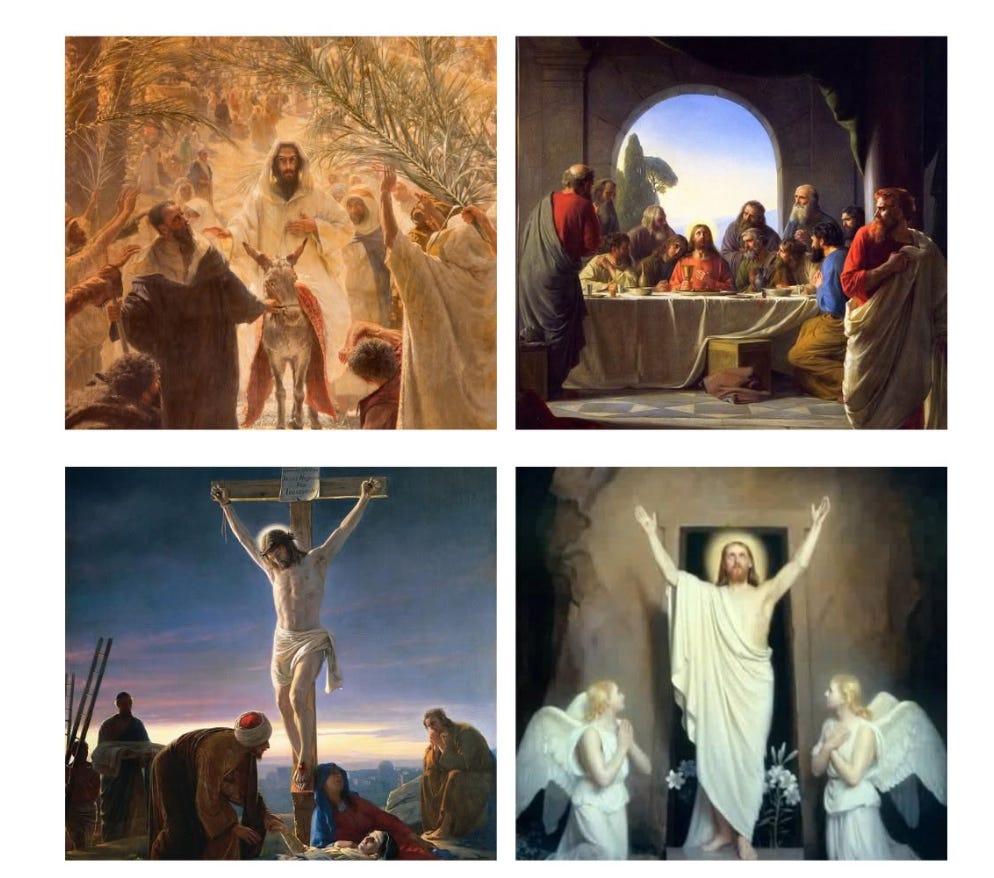
Put together, the Paschal mystery thus is the central act of Christ’s ministry on Earth. It is the sequence of events—each essential—that collectively constitute his salvific intervention in human history.
The Paschal Mystery and the Trinity
Marthaler makes an interesting observation by connecting the Paschal mystery to one of the other great mysteries of the faith; namely, the Trinity. Specifically, he argues based on the Pauline epistles, the Paschal mystery “is the work of the Triune God acting in concert.” (P. 198). The Father lifts up the Son, who is now seated at the Father’s right hand, and from whom proceeds the Holy Spirit.