

This summer I’ve been rereading Father Berard L. Marthaler’s wonderful book, The Creed: The Apostolic Faith in Contemporary Theology (AMAZON LINK), which offers a comprehensive study of the Apostles’ and the Nicene Creeds, which are the Christian Church’s foundational statements of belief. I’ve been cross-referencing Bishop Robert Barron’s study of the Nicene Creed, Light from Light (AMAZON LINK), which is a little more dense.
In this post, I take up a key line from the Nicene Creed:
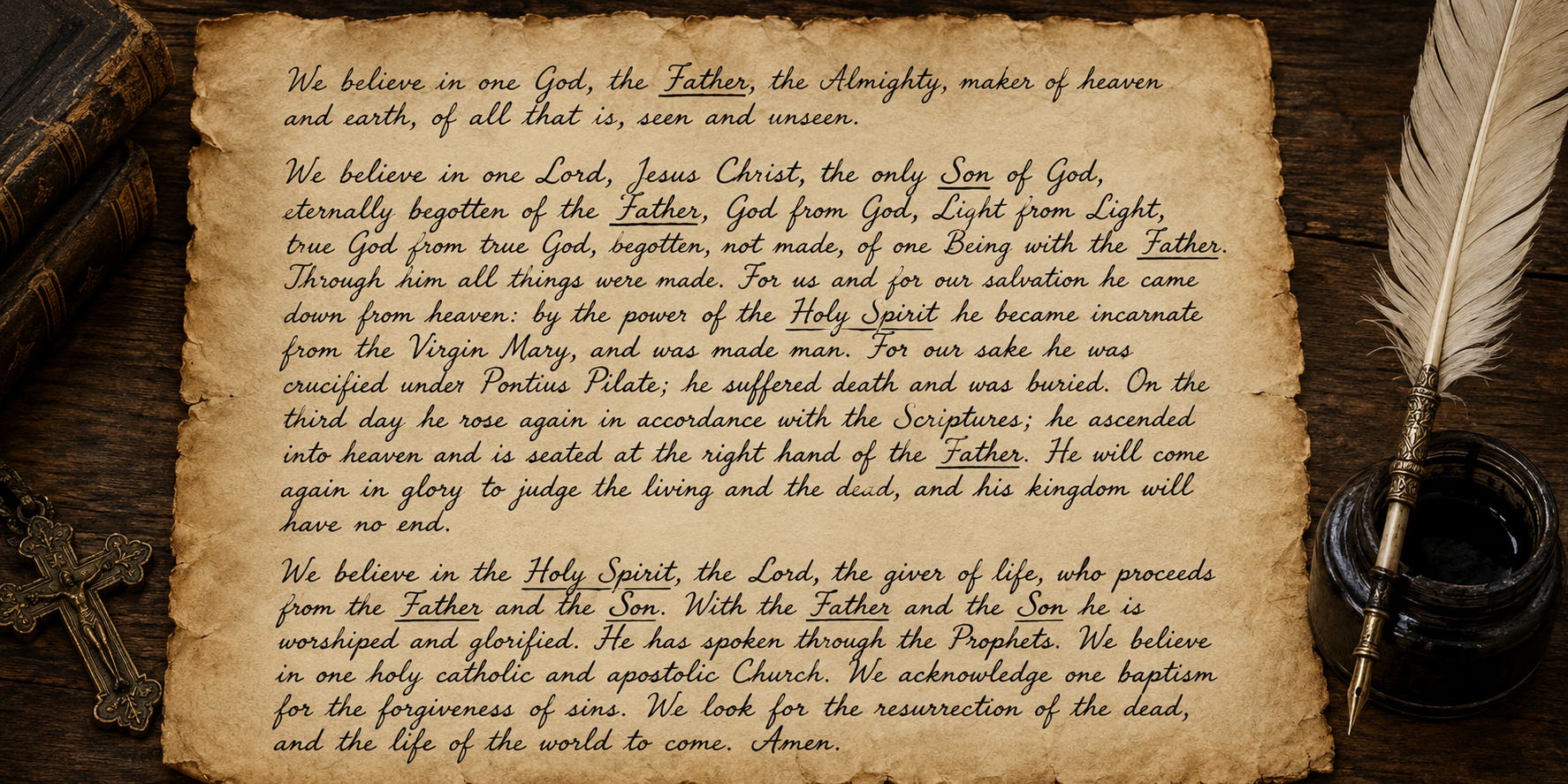
[We believe] in one Lord Jesus Christ, the only Son of God, begotten from the Father before all ages,
God from God,
Light from Light,
true God from true God,
begotten, not made; of the same essence as the Father.
Compare that lengthy description of Jesus’ nature to the much simpler one in the Apostles’ Creed:
[I believe] in Jesus Christ, his only Son, our Lord ….
The longer Nicene text was necessitated as a response to one of the Arian heresies circulating in the early part of the fourth century. Arius taught that Christ did not come into existence until after the events of Genesis 1:1 (“In the beginning, when God created the heavens and the earth ....”). Instead, Christ was created by God thereafter. Arius regarded Christ as the “first born” of God’s creatures, but insisted Christ was a creature and therefore neither co-eternal with God nor partaking of God’s essential nature.
Most of the relevant passage speaks to the Arian heresy. “True God from True God,” for example, confirms that Jesus shares God’s nature as do the other statements. But I’ve always found the word “begotten” interesting in this context.
What immediately comets mind is the series of “begats” that begins Matthew. One function of the Creedal statement this is to affirm that Jesus was not begat of Joseph, but was begat of God the Father. More important, however, “begotten” also affirms orthodox (lower case o) Christianity’s rejection of Arianism. But to see why requires us to dig into the meaning of “begotten.”
The Greek word translated as “begotten” is monogenes, which some linguists argue connotes a unique relationship. “One of a kind.” This translation makes sense in this context, since it conveys the unique relationship between God the Father and God the Son.
Other linguists translate it as “to generate,” which in this context could be understood not as creation (bringing something out of nothing) but as the process of bringing something of of something. Hence, Jesus proceeds from the Father--is generated by the Father out of the divine essence.
Christ thus proceeds from the Father, but is of the same nature. Christ thus is simultaneously God but also a distinct person begotten by the Father.