

By now most readers will have heard about President Donald Trump’s “anti-weaponization” settlement. As the WSJ explains:
President Trump has alleged for years that his opponents weaponized the legal system against him and his supporters for political gain. On Monday, his administration created an extraordinary program to pay his allies back—with taxpayer funds.
The Justice Department unveiled what it called the “Anti-Weaponization Fund,” backed by nearly $1.8 billion. It described the initiative as a resolution to a lawsuit and two administrative claims that Trump filed in his personal capacity against the government he now runs. …
[Later] the Justice Department expanded the deal to end all pending tax audits of Trump and his businesses.
In January, Trump filed a lawsuit against the Internal Revenue Service, seeking $10 billion in damages for the illegal disclosure of his tax returns by a government contractor. He also had filed administrative claims against the government seeking millions of dollars stemming from a Federal Bureau of Investigation search of his Mar-a-Lago estate in Florida and an investigation into Russian interference in the 2016 election.
Trump faced several legal hurdles in prevailing against the IRS. Instead of defending the government, Justice Department lawyers reached an agreement with the president’s personal legal team to create the fund, overseen by a commission appointed by the attorney general and subject to firing by Trump.
If this strikes you as deeply corrupt, welcome to the club. If it doesn’t, please seek help.
There’s plenty of learned commentary out there on the deal (as well as a much larger amount of unlearned commentary), so I won’t be adding to it.
But this story did remind me of an amusing anecdote from my days as a judicial law clerk.
Internal Revenue Code (IRC) § 104 provides in pertinent part that:
(a) … gross income does not include—
(2) the amount of any damages (other than punitive damages) received (whether by suit or agreement and whether as lump sums or as periodic payments) on account of personal physical injuries or physical sickness;
IRS Regulation § 1.104(c)-1(c) provides “the term damages means an amount received (other than workers’ compensation) through prosecution of a legal suit or action, or through a settlement agreement entered into in lieu of prosecution” (my emphasis).
After. the Korean War, two young people—lets call them John and Mary—married and started a family. John was a skilled carpenter who worked in the building trades. Despite union work rules, John gradually added experience as an electrician and plumber.
In the mid-1960s, John struck out on his own by starting a home repair and remodeling business. John never incorporated the business. As for other business-related paperwork, such as fictitious business name filings and the like, John pretty much ignored them too.
Despite John’s lackadaisical approach to the legal niceties of running a business, John’s business succeeded and began generating a comfortable amount of income for the family. Up to this point, Mary had been a stay-at-home mom but as the business grew she began running the office work side of the business. Mary handled bookings, billing customers, paying suppliers and other vendors, preparing their taxes, and so on.
One day John was up on a ladder at a job site. He fell off and broke his right arm. John was in a cast for seven weeks and then had to undergo several weeks of physical therapy. John ultimately was unable to work for almost three months, resulting in a considerable loss of income.
As she was preparing their federal income tax return for the year in question, Mary noticed IRC § 104 and Reg § 1.104-1. She pointed them out to John and, at her suggestion, they went to see a lawyer.
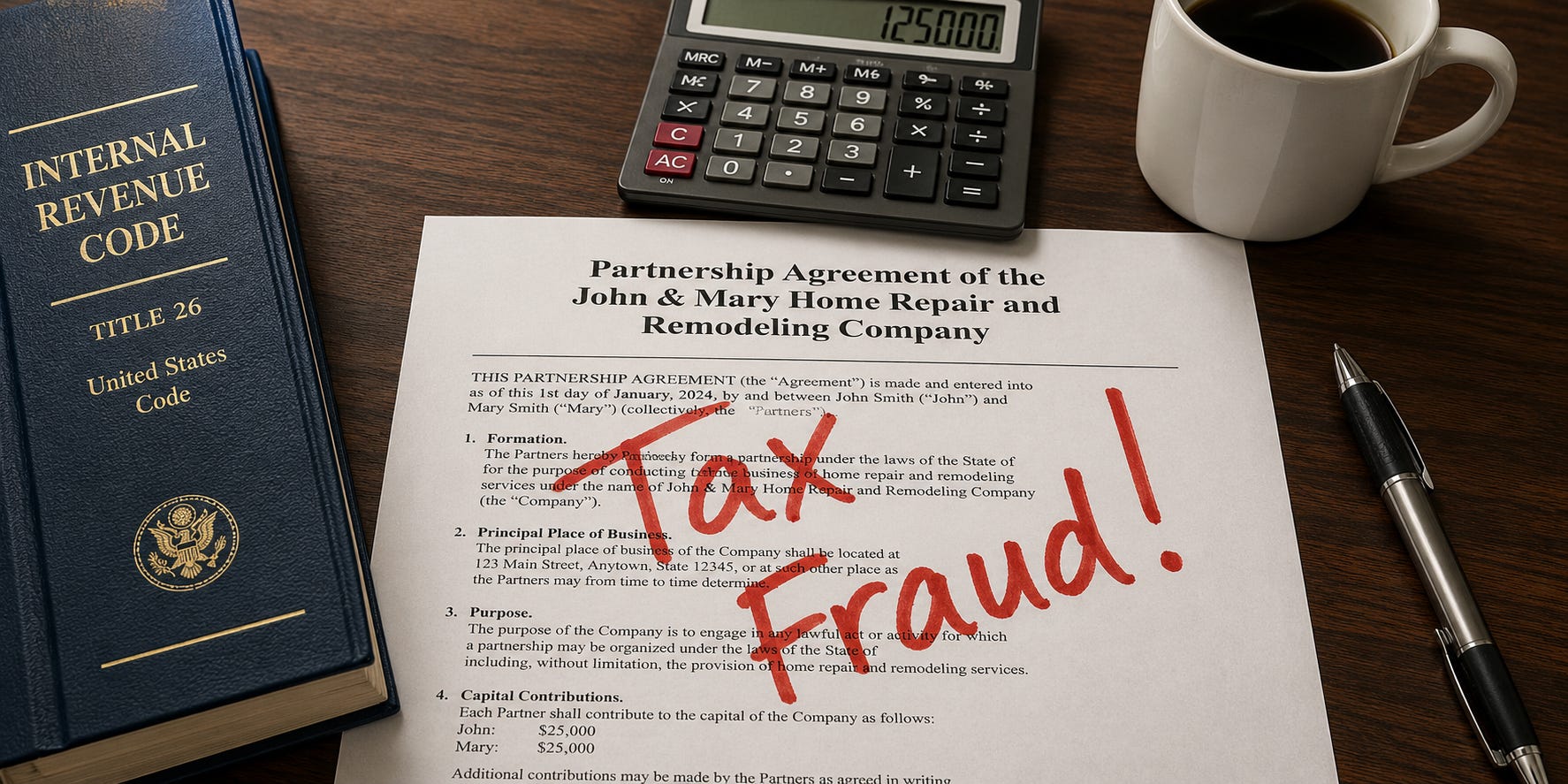
The lawyer drafted a bunch of documents for John and Mary, including:
A written partnership agreement. The first recital to the agreement stated that it reduced to writing and memorialized an oral partnership into which John and Mary had entered when the business was started.
The rest of the agreement was quite standard. It provided equal rights to profits and in management. Pretty basic boilerplate.
A fictitious business name filing for, let’s call it, John & Mary’s Repair and Remodeling Company.
A Form 1065 and Schedule K-1 for the relevant tax year.
John and Mark later went to an accountant who prepared Form 1065s for the previous three tax years, which he filed along with a Form 843 request for a waiver of late fees. The accountant also prepared amended and Form 1040s and Schedule K-1s for the previous three years.
A written employment contract between John in his capacity as the firm’s sole worker and the partnership.
A Settlement and Waiver of Claims. In his capacity as an employee of the company, John asserted claims of negligence, providing defective equipment, lack of supervision, and so on against the company. In their capacities as partners, John and Mary acknowledged their liability. The settlement was for $4 million to be paid in installments over a period of 20 years. The annual installment payment was to equal the company’s earnings for the year in question. So, for example, if in Year 4 the partnership had pre-settlement payment earnings of $100,000, that year’s installment payment would be $100,000,
You will see, of course, that John and Mary had thereby zeroed out their taxable income for what we likely to be the remainder of John’s working life.
This went on for some years until the IRS finally noticed it. They IRS promptly audited John and Mary and imposed an enormous amount of back taxes, penalties, and interest. When John and Mary objected, the IRS began making noises about criminal tax fraud charges.
John and Mary paid the IRS what they owed, but then—and this is my favorite part—sued in federal district court to recover their payments.
The case landed in front of my judge.
John and Mary acted pro se.
The judge held an evidentiary hearing on the IRS motion for summary judgment. John and Mary were remarkably cheerful and candid. The IRS attorney was a Cylon. No sense of humor. No suggestion that she thought John and Mary were cute (they really were an adorable couple). No willingness to budge an inch. She kept mumbling something about tax fraud indictments. Basically, she struck me as somebody who would have been one of Torquemada’s best inquisitors.
After the hearing, my judge barely made it back to chambers before he cracked up. He told me to turn my bench memo into a letter opinion ruling for the IRS, but only after saying he wished there was someway he could find for John and Mary. They were just so likeable and matter of fact about the whole thing.
Legal Ethics Question: If you had been John and Mary’s lawyer, would you have felt comfortable doing what their actual lawyer did? If you had done the same things for a client, would your state bar discipline you?
Partnership Law Question: The key preliminary issue is whether John and Mary had a valid partnership. If not, the whole scheme falls apart—setting aside the many other problems with the scheme. Did they have a valid partnership?
Prosecutorial Discretion Question: If you had been the head of the IRS enforcement division, would you have sued John and Mary or just let it slide?
Who would you rather have over for dinner? John and Mary or Trump?
Comments enabled.