

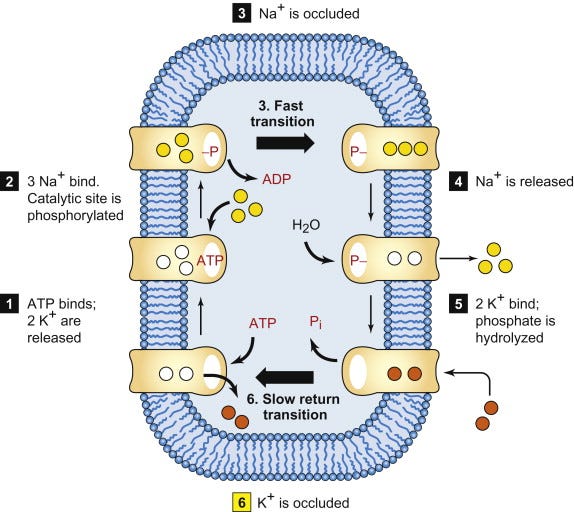
Before I became a lawyer and legal academic, I was a scientist. My undergraduate degree was in Chemistry. My Master’s degree was in Biochemistry (specifically biophysical inorganic chemistry). My thesis was entitled “Lithium NMR Studies of the Sodium-Potassium Adenosine Triphosphatase,” a study of the active site of the so-called sodium-potassium pump.
As such, I was steeped in biological sciences, including evolution.
Of course, I am also (and was then) a devout Christian who believes the Bible is the inspired word of God.
Faith and Science
As a Catholic, there is no conflict between my faith and my belief that the scientific account of evolution is correct.
The Catechism states:
The question about the origins of the world and of man has been the object of many scientific studies which have splendidly enriched our knowledge of the age and dimensions of the cosmos, the development of life-forms and the appearance of man. These discoveries invite us to even greater admiration for the greatness of the Creator, prompting us to give him thanks for all his works and for the understanding and wisdom he gives to scholars and researchers. With Solomon they can say: "It is he who gave me unerring knowledge of what exists, to know the structure of the world and the activity of the elements. . . for wisdom, the fashioner of all things, taught me." (§ 283)
Pope John Paul II thus declared “there is no conflict between evolution and the doctrine of the faith.” Indeed, he recognized that “new findings lead us toward the recognition of evolution as more than an hypothesis.”
Catholicism thus does not teach the literal 6-day Creationism propounded by some fundamentalists. Instead, it adopts a form of theistic evolution.

The Creation Account
Catholics reconcile the competing claims of faith and science by viewing the Genesis account of creation as a theological and spiritual narrative rather than a literal, scientific history. Catholics thus do not interpret Genesis as a modern biology or physics textbook, but rather as divinely inspired truth told through poetry, metaphor, and figurative language. As Bishop Robert Barron has said, the Genesis creation accounts (there are two) should be understood “as they were meant to be seen: not as primitive science, but as exquisite theology.”
A Literal Adam?
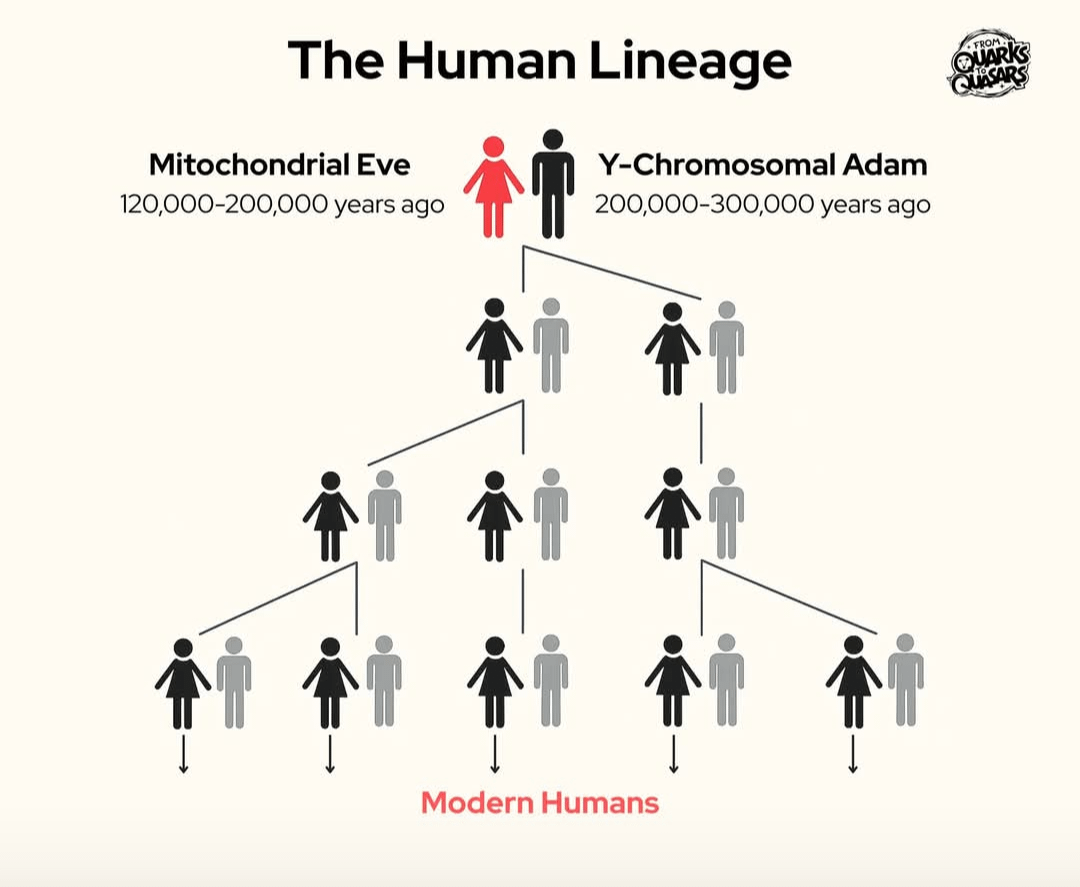
Given all of that, I have long assumed that there was no literal Adam and Eve, setting aside the question of whether there was a single mitochondrial Eve and Y-chromosome Adam.
But, the knowledgeable reader will ask, what about Pope Pius XII’s statement in Pius XII in Humani Generis?
For the faithful cannot embrace that opinion which maintains that either after Adam there existed on this earth true men who did not take their origin through natural generation from him as from the first parent of all, or that Adam represents a certain number of first parents.
Pope Pius is propounding what theologians refer to as monogenism; i.e., that Adam and Eve were the literal and sole progenitors of all of humans. As compared with polygenism.

For an excellent Catholic defense of polygenism, see Nicanor Pier Giorgio Austriaco, O.P., James Brent, O.P., Thomas Davenport, O.P., and John Baptist Ku, O.P.’s book Thomistic Evolution: A Catholic Approach to Understanding Evolution in the Light of Faith. (AMAZON LINK) (The O.P. stands for Order of Preachers—Latin: Ordo Praedicatorum—which is more commonly known as the Dominican Order.)
Stumbling Across an Islamic Perspective
I tee up all of the foregoing as an introduction to an article I recently stumbled across offering an Islamic perspective on these questions. I cannot vouch for the validity fo the author’s interpretation of Islamic theology, of course, but I thought it was a very interesting treatment of an issue that I’ve occasionally pondered.
Oruj Ismayilov, Was Adam the First Biological Human? A Qur'anic Account of Human Origins as a Metaphysical Turning Point (December 28, 2025). Available at SSRN: https://ssrn.com/abstract=5985675 or http://dx.doi.org/10.2139/ssrn.5985675
The gist of the argument is that:
… the physical substrate of humanity (bashar) developed through evolutionary processes documented by paleoanthropology and genetics, the essential qualities that constitute humanness—consciousness, volitional agency, and moral responsibility—were realized through a metaphysical endowment described in the Qur’an as nafkh al-rūḥ (the inbreathing of the spirit). This intervention did not contradict or supersede natural processes but rather completed them, transforming a biologically evolved organism into a morally accountable subject.
A Quick Catholic Digression
I note that this seems to be a similar argument to that made by Catholic scholar Edward Feser, who posits that:
There is nothing at all contrary to what Pius says in Humani Generis in the view that 10,000 (or for that matter 10,000,000) creatures genetically and physiologically like us arose via purely evolutionary processes. For such creatures -- even if there had been only two of them -- would not be “human” in the metaphysical sense in the first place. They would be human in the metaphysical sense (and thus in the theologically relevant sense) only if the matter that made up their bodies were informed by a human soul -- that is, by a subsistent form imparting intellectual and volitional powers as well as the lower animal powers that a Planet of the Apes-style “human” would have. And only direct divine action can make that happen ….
Supposing, then, that the smallest human-like population of animals evolution could have initially produced numbered around 10,000, we have a scenario that is fully compatible with Catholic doctrine if we suppose that only two of these creatures had human souls infused into them by God at their conception, and that He infused further human souls only into those creatures who were descended from this initial pair.
Back to Islam
As the quote above suggests, Ismayilov argues that Adam should not be understood as the first biological Homo sapiens, but as the first fully volitional and morally responsible human. Its central model distinguishes bashar, the evolved biological human organism, from insān, the ensouled human person endowed with consciousness, free will, symbolic thought, and moral accountability.1 In this view, biological evolution prepared the human body through taswiyah—proportioning or refinement—while nafkh al-rūḥ,2 the Qur’anic “inbreathing of the spirit,” marks a metaphysical transition from biological life to morally accountable personhood.3
Ismayilov presents this as a way to reconcile evolutionary biology with Qur’anic anthropology: evolution explains the bodily substrate, while revelation explains consciousness, moral agency, and spiritual vocation. Adam’s “firstness” is therefore metaphysical rather than biological: he is the first bearer of the divine trust and the prototype of humanity as insān.
Ismayilov is not trying to prove the soul scientifically. His aim is philosophical and theological; namely, to show that Islamic belief in Adam, divine creation, and human moral dignity can be interpreted in a way that remains compatible with evolutionary biology.
A major strength of Ismayilov’s paper is that he openly admits the model is not an empirical scientific hypothesis. He treats nafkh al-rūḥ as a philosophical-theological explanation, not something archaeology or neuroscience can directly verify. He also acknowledges unresolved problems, including the timing of ensoulment, the status of Neanderthals and Denisovans, and how his model fits with classical interpretations that treat Adam as the first biological human. The core problem, of course, is the difficulty of identifying where biological cognition ends and metaphysical moral agency begins.
Conclusion
In many respects, I found this paper quite illuminating. It struck me as a well thought out attempt to reconcile faith and science with respect to the core question of human origin.
The paper’s core distinction is between bashar and insān. Bashar refers to the biological human organism: the evolved, embodied Homo sapiens produced through natural processes. Insān refers to the morally responsible human person: a being with consciousness, free will, symbolic thought, and accountability before God.
Nafkh al-rūḥ, the Qur’anic “inbreathing of the spirit,” marks what Ismayilov identifies as the decisive metaphysical transition. It marks the point at which a biologically evolved human becomes a conscious, morally responsible, spiritually accountable person. This is the paper’s explanation for what biology alone cannot fully account for: subjective consciousness, free will, and moral agency.
Ismayilov interprets biological evolution as taswiyah, meaning divine proportioning, refinement, or preparation. Human evolution is therefore not treated as a denial of creation, but as the process by which the biological vessel was prepared for a higher metaphysical endowment.