

Some years ago, Gordon Smith and Andrew Gold invited me to contribute a chapter to a volume of essays on fiduciary law that they were editing. They gave me free rein to pick an appropriate topic, which prompted me to do some out of the box thinking. I ended up picking a topic more than a little out of the usual run of law essay collections.
As I have discussed in past posts, one of my long standing areas of vocational interest is the intersection of theology, economics, and law. Usually the direction of travel is:

This is particularly true of my work using Catholic social thought to inform my analysis of some legal issue. See, e.g., Christianity and Corporate Purpose, in Christianity and Market Regulation: An Introduction 101 (Cambridge University Press; Daniel A. Crane & Samuel Gregg eds. 2021).
In this case, however, the direction of travel flipped into something more like this:
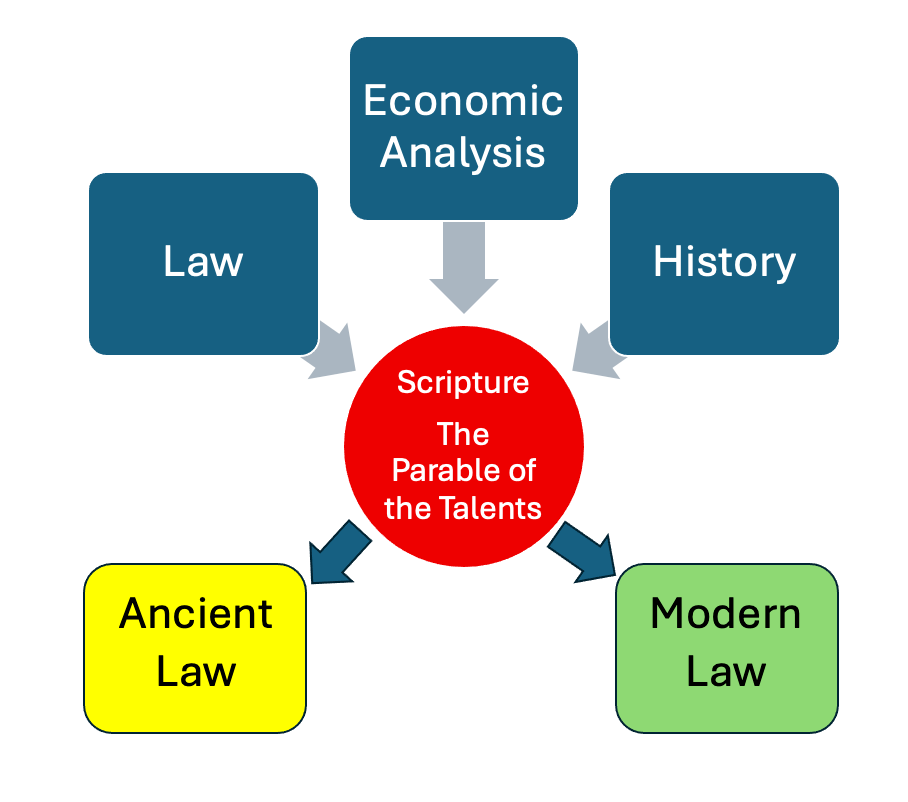
The result was Parable of the Talents, in Research Handbook on Fiduciary Law 97 (Edward Elgar Publishing; D. Gordon Smith & Andrew S. Gold eds. 2018) (AMAZON LINK), a working version of which is available on SSRN.
As Scott Pryor observed of this project:
His piece is not theological as typically understood. Instead, Bainbridge sets out to answer some legal questions: “What was the relationship between the master and the servant? What were the servants’ duties? How do the likely answers to those questions map to modern relations, such as those of principal and agent?” These questions are not merely some jejune inquiries from someone with nothing better to do. As Bainbridge notes, the modern common law of fiduciary relations is grounded more directly than any other field of private law on distinctly moral and even religious notions of duty. To understand the modern notion of fiduciary (= faithful) relationships, Jesus’ parable(s) in light of the legal backdrop of first-century Judea might prove helpful.
I think that’s mostly right. “Fiduciary law is aimed at allowing people to use the talents of strangers and reduce their cost of verification,”1 which is precisely the problem faced by the master in the Parable.
But I would offer, as a friendly amendment, the thought that I also hoped bringing to bear historical, legal, and economic analysis on the Parable would allow us to also better understand its theological implications.
The Parable
On its surface, Jesus’ Parable of the Talents is a simple story with four key plot elements: (1) A master is leaving on a long trip and entrusts substantial assets to three servants to manage during his absence. (2) Two of the servants invested the assets profitably, earning substantial returns, but a third servant—frightened of his master’s reputation as a hard taskmaster—put the money away for safekeeping and failed even to earn interest on it. (3) The master returns and demands an accounting from the servants. (4) The two servants who invested wisely were rewarded, but the servant who failed to do so is punished.
Sidebar
Two of the synoptic Gospels—Matthew and Luke—contain versions of the Parable. The two versions are largely similar but differ in some particulars. The majority viewpoint among scholars is that the two versions likely were taught at different times. Matthew’s version was part of an eschatological sermon, while Luke’s version was taught as Jesus and his disciples traveled to Jerusalem en route to the Last Supper. Having said that, however, as Paul Johnson observes, both take “as a fact of life the economics of worldliness, commend[] lending at high interest, and cite[] the wisdom of a lord who reaps ‘where [he] hast not sown’ and gathers ‘where [he] hast not [strewn].’”Paul Johnson, Jesus: A Biography from a Believer 117 (2010) (AMAZON LINK). My analysis focused on Matthew’s version.
The Theological Lesson
I am particularly struck by the juxtaposition in Matthew of the Parable of the Talents and the Parable of the Judgment of the Nations (a.k.a. the Parable of the Sheep and the Goats).
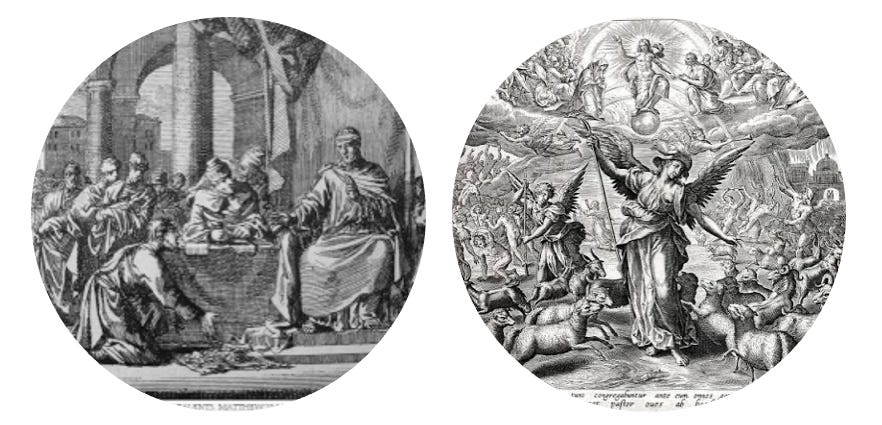
The basic theological lesson Jesus presumably intended those who heard the former is the obligation of his followers to earnestly labor in service of the Kingdom of God. His followers were not to hide their light under the proverbial bushel, but rather to use their talents (if you will pardon a weak pun) to the fullest extent of their abilities to fulfill the Great Commission. The latter drives home the message by starkly illustrating the fate of those who fail to care for those for whom Jesus had especial regard. As Paul Johnson observed in A Biography from a Believer:
Jesus immediately passes [from the Parable of the Talents] to the judgment where the unworldly are divided from the worldly: “And he shall set the sheep on his right hand, but the goats on the left” (Mt 25:33). He tells the sheep: “Come, ye blessed of my Father, inherit the kingdom prepared for you” (25:34). Jesus goes on to explain that those in this world who feed the hungry and the thirsty, and who take in homeless strangers, and who clothe the naked, and who visit the sick and the imprisoned shall be rewarded, and he makes the striking point that whoever befriends “the least of these my brethren, ye have done it unto me” (25:40).
The lesson is unmistakable, as Pryor observed:
[The Parable teaches that,] for God’s people in the about-to-be-inaugurated messianic age, the pattern of life would no longer be the pattern of the nation of Israel as a relatively static exemplar of God’s rule in the world. Instead, with the decoupling of God’s people from a single ethnic group and a single piece of land, and with the empowering of the Spirit, God’s people were to adopt an affirmative, outward-directed understanding of their place in the world. To be sure, Jesus wasn’t advocating a crass health-and-wealth gospel, such is to reduce the eschatological to the material, but he was (and is) urging on his followers a mission that will be characterized by world-wide growth and expansion with “profits” measured in terms of increasing numbers of followers from every tribe, tongue, and nation.
The Legal Backstory
The goal of Jesus’ parables was to stimulate thought, encourage people to think for themselves, and thus to puzzle out religious mysteries.
In order to facilitate that process, the parable was told as if it were a true tale—even if sometimes a highly improbable one—that the listeners could accept as a factual basis from which to extrapolate theological lessons. Put another way, Jesus’ parables were effective as teaching tools precisely because his listeners “could readily identify with the roles people filled, work that they did, relations that were broken and restored, losses they sustained and happiness they experienced.”2
Neither the master nor any of the servants make any appeal to legal standards, but it seems improbable that there was no background set of rules against which the story plays out.
The Parable of the Talents thus likely was premised on a legal backstory about the fiduciary duties of servants that would have been well understood by those who heard the Parable, which permits us to draw inferences about the contents of that background law.3
To the legal mind, the Parable thus raises some interesting questions: What was the relationship between the master and the servant? What were the servants’ duties? How do the likely answers to those questions map to modern relations, such as those of principal and agent? Curiously, however, there are almost no detailed analyses of these questions in Anglo-American legal scholarship.
My project sought to fill that gap.
The analysis leads to several conclusions:
Modern fiduciary law can be based on either proscriptive or prescriptive standards.
Anglo-Australian law, for example, imposes only proscriptive standards. In particular, an agent’s sole fiduciary duty under their laws is that of undivided loyalty.
In contrast, prescriptive standards impose affirmative duties, instructing the fiduciary what he must do. American and Canadian law, to cite two examples, includes both proscriptive and prescriptive standards.
My analysis suggests that First Century Jewish civil law was closer to the American-Canadian model, as the master clearly expected the servants to affirmatively act in his interests.
How should we understand the severity of the sanction? How does the severity with which the unfaithful servant was punished contrast to modern law?
Agency-type relationships have the same basic structure and same basic flaws, regardless of time and place.
A Minor Digression
One of the interesting differences between the two versions regards the behavior of the lazy servant. In Matthew’s account, the servant “went off and dug a hole in the ground and buried his master’s money.” But in Luke’s account the servant “kept it stored away in a handkerchief.”
According to some scholars, Jewish law of the period would have treated the latter more severely than the former:
[B]urying was regarded as the best security against theft. If a person entrusted with money buried it as soon as he took possession of it, he would be free from liability should anything happen to it. For money merely tied up in a cloth, the opposite was true. In this case, the person was responsible to cover any loss incurred due to the irresponsible nature of the deposit.4
Presumably, a treasure carefully buried was regarded as being less susceptible to theft or other loss than one simply wrapped up in a cloth and left who knows where.
In the Parable, however, Jesus flips that rule. The servant who wrapped the money in a cloth merely has the money taken away from him and must watch it being given to the first faithful servant. In contrast, the servant who buried the money is thrown “into the darkness outside, where there will be wailing and grinding of teeth.”
Perhaps Jesus introduced this twist to grab his audience’s attention and thereby drive home the message that there are severe consequences for those who fail to use their full talents in service of the Kingdom of God. Recall that the Matthean Parable—in which the servant buried the talent—is situated immediately before the parable of the sheep and the goats. The severe punishment of the unfaithful servant in the Matthean Parable thus may have been intended to help the audience grasp the fate awaiting the goats.
Yet, there may be a secular explanation as well. In First Century Judea and Galilee, Roman rule was facilitating a shift from an agrarian economy in which reciprocity was the dominant form of exchange to a more market-oriented economy in which trading was becoming dominant. The earlier period was dominated by a limited goods economy in which most goods were subject to a fixed level of supply and trade was a zero-sum game, so that making money meant that somebody else lost money. In the emerging new economy, however, trading and investing for a return were becoming commonplace.
The older rules made sense in the economic conditions of the period in which they developed, where protecting the value of the goods one already owned might have seemed more important—and socially responsible—than trying to increase their value. In the new increasingly market-based economy, where the supply of goods was no longer fixed and trade was facilitated by the increasing use of money as a unit of exchange rather than barter, however, trade was no longer a zero sum game. Instead, it could produce surplus wealth that came from wealth creation rather than wealth transfers. The Parable presumably reflects the expectations of a master operating in this new environment, while the unfaithful servant’s worldview was still based in the mores of the older period.
Options
I hope you read the essay. But you might prefer to watch a video I made on the project. In either case, I hope it is of interest.
Tamar Frankel, Fiduciary Law in the Twenty-First Century, 91 B.U. L. Rev. 1289, 1292 (2011).
Simon J. Kistemaker, Jesus As Story Teller: Literary Perspectives On the Parables, 16 Masters Seminary J. 49, 52 (2005).
See Robert A. Sirico, The Entrepreneurial Vocation, 3 J. Markets & Morality 1, 15 (2000) (“The Parable of the Talents … presupposes a local understanding of the proper stewardship of money.”).
Id. at 15-16.