

As you probably know, being the sort of intelligent and knowledgeable person who reads my journal, § 1 of the Fourteenth Amendment to the US Constitution provides that:
All persons born or naturalized in the United States, and subject to the jurisdiction thereof, are citizens of the United States and of the State wherein they reside.
The conventional understanding of that provision was that it guaranteed birthright citizenship; i.e., if you were born in the US, you automatically became a US citizen regardless of whether your parents were citizens.1
On January 20, 2025, President Donald Trump signed Executive Order 14160, in which he stated that:
It is the policy of the United States that no department or agency of the United States government shall issue documents recognizing United States citizenship, or accept documents issued by State, local, or other governments or authorities purporting to recognize United States citizenship, to persons: (1) when that person’s mother was unlawfully present in the United States and the person’s father was not a United States citizen or lawful permanent resident at the time of said person’s birth, or (2) when that person’s mother’s presence in the United States was lawful but temporary, and the person’s father was not a United States citizen or lawful permanent resident at the time of said person’s birth.

If given effect, the order significantly reduced the scope of birthright citizenship; specifically it sought to eliminate citizenship for children of undocumented aliens living in the US and the purported practice of “birth tourism” whereby people lawfully enter the US and have babies (intentionally or otherwise) while here.
The Executive Order sparked considerable outrage and generated multiple lawsuits challenging it. One of those is now pending before the US Supreme Court, Trump v. Barbara. It’s scheduled for oral argument on April 1 of this year. (I’m trying to work up a quip about the argument being held on April Fool’s Day.)
I’m not a constitutional law nor an immigration law expert, so I haven’t commented on the case previously and probably would not have done so. But then I saw that the United States Conference of Catholic Bishops (USCCB) has filed an amicus brief in the case.2 The USCCB has filed amicus briefs in a substantial number of cases, on issues ranging from abortion to religious liberty (collected here).
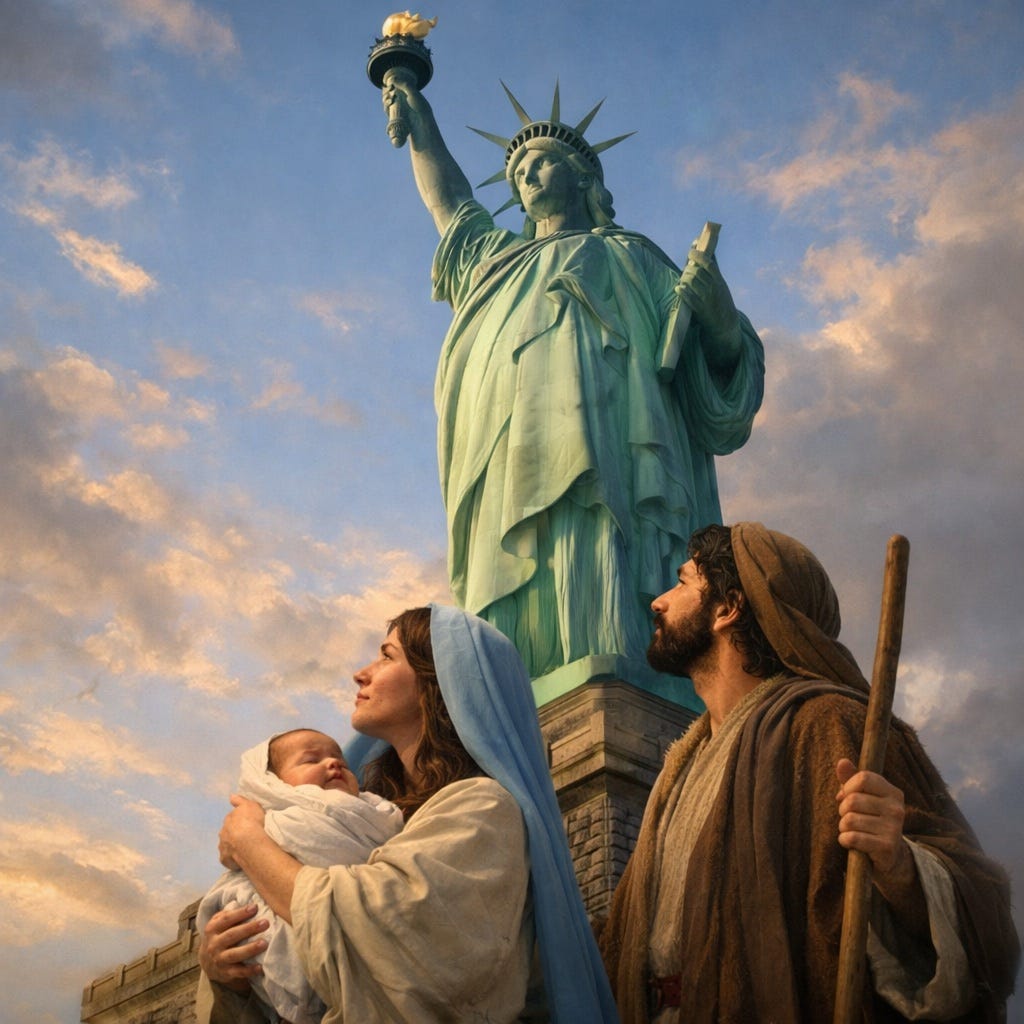
As a lawyer and practicing Catholic, that development seemed noteworthy enough to justify digging into it.
To be clear, nothing I say in this post is intended to address the constitutional merits of birthright citizenship. There are smart, extremely knowledgeable folks for whom I have great respect on both sides of the constitutional argument. My interest here is in assessing the Bishop’s argument from the perspective of the Bible and Catholic teaching.
The Brief’s Main Arguments
In addition to arguing that birthright citizenship is a sound constitutional doctrine, which I won’t discuss (see above), the amicus brief also argues that it is deeply rooted in Western legal tradition and Catholic social teaching.
Western Legal and Social Tradition
As to the former, the brief situates birthright citizenship within a long lineage of Western jurisprudence, particularly the doctrine of jus soli stemming from Roman law and which was articulated in English common law centuries ago (e.g., Calvin’s Case, 1608).
This history demonstrates that birthright citizenship is neither an innovation nor an aberration, but a deeply rooted principle of the Western legal tradition—one that the United States consciously embraced and constitutionalized in the wake of grave moral and legal failure.
It’s one of the best rhetorical moves in the brief, as it frames the Fourteenth Amendment not as creating a new rule, but as formalizing an inherited legal tradition. I assume it is intended to appeal to the originalists on the Court.
But this line of argument doesn’t strike me as a slam dunk. Critics who believe in a living Constitution likely would argue that opponents might contend that modern migration patterns differ significantly from those of 1608 or 1868, requiring an updated interpretations. They would also argue that simply being rooted in tradition does not automatically establish moral or constitutional correctness.
But I don’t buy the living Constitution approach. To me the biggest part of the problem with this line of argument was captured by a rather snide commentator on X:

As I understand the history, many Western legal systems have long based their citizenship rules on jus sanguinis (citizenship by descent). If so, the Western tradition has never been exclusively territorial.
Catholic Social Teaching: Relevance?
Before turning to the portion of the brief dealing with Catholic doctrine, let us pause to consider what relevance that line of argument has in a Supreme Court brief.
The brief claims (as a major section heading) that the “Executive Order is immoral.” It is true that there are six Catholic justices at the moment, but opinions differ widely on what role their religion should play in judicial decision making (that would be a good topic for a future post(s)).
In my view, this is a rhetorically aggressive move that is unlikely to persuade any justice not already in agreement. I haven’t done appellate advocacy since my moot court days back in law school, but I was taught that effective appellate advocacy—especially in an amicus posture—should frame arguments in terms of legal consequences and human impacts rather than direct moral condemnation of the opposing party's policy.
Indeed, the Bishops were well positioned to make an argument focused on practical human impacts. As they note, for example, the “Catholic Legal Immigration Network, Inc. (‘CLINIC’) is a national non-profit organization established in 1988 by the USCCB.” It has 415 immigration law programs across the country with 3,000 legal professionals who assist 500,000 immigrants a year. The impact on those the Church helps in that and other ways might have been a stronger point on which to focus.3
In addition, I find the brief rhetorically ambiguous and confusing. The brief’s thesis oscillates between two distinct claims: (a) the Executive Order is unconstitutional, and (b) it is immoral. Part I attempts the former, but largely grounds its arguments in moral teachings. Part II is almost entirely devoted to the latter, but never explains to the Court why the immorality of a policy bears on its constitutionality. Courts don’t strike down executive orders because they violate Church teaching.
For a Supreme Court brief, this is a meaningful gap. An amicus should either (a) argue that moral tradition informs constitutional interpretation (a textualist/originalist theory worth developing), or (b) openly acknowledge its role is purely persuasive on policy grounds. The brief tries to do both without committing to either. As a result, the brief fails to demonstrate why Catholic teaching should move a secular court's constitutional analysis.
Evaluation the Moral/Theological Argument
The brief makes three moral arguments grounded in Catholic teaching:
Human dignity: “The Church sees in men and women, in every person, the living image of God himself.”
Hence, the Bishops’ brief argues, citizenship is not merely an administrative status, it is a recognition of ontological worth. The logic proceeds as follows:
Human beings bear divine image → human dignity is inherent → political authority must respect that dignity → laws that deny recognition at birth risk denying dignity.
The integrity of the family: “Because the family is the foundational unit of society—the ‘original cell of social life’—Catholic teaching consistently rejects state actions that undermine family integrity.”
Destabilizing children’s legal status destabilizes the family itself. In Catholic social teaching, the state’s authority is subordinate to the moral priority of the family.
Subsidiarity: “The principle of subsidiarity teaches that larger social institutions must not overwhelm or displace smaller, more immediate communities, particularly the family, which the Church recognizes as ‘the first and vital cell of society.’”
This is the brief's most intellectually interesting contribution. The brief’s argument that birthright citizenship operationalizes subsidiarity—by embedding a child in community structures from birth and enabling participation in them—is creative and, I suspect, not commonly seen in constitutional litigation. It gives the brief a distinctive Catholic voice.
Subsidiarity is a core Catholic doctrine. In paragraph 1883, the Catechism teaches that "a community of a higher order should not interfere in the internal life of a community of a lower order, depriving the latter of its functions, but rather should support it in case of need.”
Subsidiarity is closely linked to federalism; indeed, subsidiarity is arguably the moral underpinning of federalism. Hence, this argument may well have appeal to the members of the court who value federalism. (So why didn;t the brief make it?)
On the other hand, a Westlaw search turned up only one case in which subsidiarity was discussed, U.S. v. Morrison,4 and the discussion was limited to Justice Breyer’s dissent.5 So it’s not an argument the Court is used to hearing.
As a practicing Catholic, of course, I give religious assent to all three principles. But God gave us minds to consider and evaluate, so let’s spend a minute or two on a conflict in Catholic teaching that the Bishop’s brief just sort of slides right by.
The Catholic Catechism teaches that nations do have a right to control their borders:
Political authorities, for the sake of the common good for which they are responsible, may make the exercise of the right to immigrate subject to various juridical conditions, especially with regard to the immigrants' duties toward their country of adoption.
The Bishops acknowledge this but only in a single dependent clause: “the Church recognizes the legitimate authority of sovereign nations to regulate immigration and secure their borders. …” But the independent clause of that sentence immediately switches to another Church teaching: “this authority includes a corresponding duty to protect the God-given dignity of every human person.”
This is (arguably) and example of a classic Catholic theological move: “both/and.” This is a foundational theological principle, which embraces paradox by holding seemingly opposing truths in harmony. It avoids “either/or” fallacies to emphasize a holistic view—such as grace and nature, faith and reason, or scripture and tradition—reflecting a “fullness” of faith.6
Both the grammatical structure of the brief’s statement and the text of the argument suggest that human dignity comes first. And I find that very Biblical:
“You shall not oppress a resident alien; you well know how it feels to be an alien, since you were once aliens yourselves in the land of Egypt.” Exodus 23:9.
“For the LORD, your God, is the God of gods, the Lord of lords, the great God, mighty and awesome, who has no favorites, accepts no bribes, who executes justice for the orphan and the widow, and loves the resident alien, giving them food and clothing. So you too should love the resident alien, for that is what you were in the land of Egypt.” Deuteronomy 10:17-19.
“You shall treat the alien who resides with you no differently than the natives born among you; you shall love the alien as yourself; for you too were once aliens in the land of Egypt.” Leviticus 19:34.
Conclusion
I came away from the brief disappointed. Again, I will concede that constitutional law, immigration law, and appellate advocacy are not in my wheelhouse. Nevertheless, I think the brief would have been much stronger if it had made three different moves. First, it should have engaged the "subject to the jurisdiction" textualist debate directly, using natural law and Western tradition arguments to support the originalist case for broad birthright citizenship. Second, it should have developed the statelessness issue into a cognizable legal argument under international law. Third, it should have reserved the theological material for a narrower, more tightly integrated role. The current structure—moral argument bolted onto thin constitutional analysis—is unlikely to persuade anyone not already persuaded.
Having said that, however, the brief may have been intended for a broader audience than just the nine Justices and their law clerks.
Our nation has not exactly been treating “the alien who resides with [us] no differently than the natives born among you.” To the contrary, what we saw in Minneapolis and elsewhere smacks of oppression. As a call to action, the brief’s moral arguments deserve a wide audience.
Long standing minor exceptions carved out a small number of individuals who did not become citizens by birth, such as children of foreign diplomats.
The USCCB defines itself as “is an assembly of the hierarchy of bishops who jointly exercise pastoral functions on behalf of the Christian faithful of the United States and the U.S. Virgin Islands.” Among its five stated civil purposes is “to care for immigrants.”
The USCCB’s religious existence is premised on the Code of Canon Law, which provides that:
Can. 447 A conference of bishops, a permanent institution, is a group of bishops of some nation or certain territory who jointly exercise certain pastoral functions for the Christian faithful of their territory in order to promote the greater good which the Church offers to humanity, especially through forms and programs of the apostolate fittingly adapted to the circumstances of time and place, according to the norm of law. …
Can. 449 … §2. A legitimately erected conference of bishops possesses juridic personality by the law itself.
Can. 450 §1. To a conference of bishops belong by the law itself all diocesan bishops in the territory, those equivalent to them in law, coadjutor bishops, auxiliary bishops, and other titular bishops who perform in the same territory a special function entrusted to them by the Apostolic See or conference of bishops. Ordinaries of another rite can also be invited though in such a way that they have only a consultative vote unless the statutes of the conference of bishops decree otherwise.
The brief does engage practical consequences in one section, arguing that:
Stateless people lack access to basic services necessary for integration into society, such as education, employment, health care, documentation, and financial support.
This section shifts the argument from moral principle to practical consequence. Restricting birthright citizenship creates systemic vulnerability, which is not only a legal anomaly but a potential humanitarian crisis. This section usefully integrates both Catholic social teaching and governance concerns.
I would thus argue that the statelessness discussion is actually the brief's most compelling contribution to the debate. Yet, the brief doesn't fully develop the legal significance of statelessness (e.g., U.S. treaty obligations, the 1954 Statelessness Convention). It remains at the level of moral concern rather than legal argumentation.
529 U.S. 598 (2000).
Id at 656 (Breyer, J., dissenting). Justice Breyer wrote that subsidiarity as used in European law is “somewhat analogous” to US law’s principle of federalism. Id. at 663.