

Today’s post is about one of my personal heroes. Someone who daily inspires me.
Canonization
Canonization is the process by which the Roman Catholic Church formally recognizes that an individual lived a life of heroic virtue and is now in Heaven. It is a four-step process1:
Initiation: The local bishop—usually of the diocese in which the candidate died—opens an investigation into the candidates life, collecting testimony and written records. If the Vatican’s Dicastery for the Causes of the Saints agrees,2 the candidate is named a Servant of God.
Declaration. If the diocese’s and the Dicastery’s investigation finds evidence that the candidate lived a life of heroic virtue, they can recommend that the Pope declare the Candidate to be “Venerable.” Only the Pope has this power. Catholics can ask the Venerable to intercede with God on their behalf.3 Contrary to what some Protestants claim, we do not worship the Venerable (of a saint, for that matter). Rather, we ask them to intercede in Heaven on our behalf.
Beatification. If the Dicastery determines that a miracle—usually defined as a scientifically inexplicable healing—can be attributed to the Venerable’s intervention, it can recommend that the the Pope beatify the candidate. If the Pope does so, the candidate is now referred to as “Blessed.” A miracle is not necessary if the Dicastery determined that the candidate was a martyr.
Canonization. If the Dicastery determines that a second miracle can be attributed to the candidate’s intervention, it can recommend sainthood. If the Pope agrees, he can declare the individual to be a saint.
The Congressional Medal of Honor
Although there are separate statutes defining the conditions under which the President may award the Congressional Medal of Honor for each of the Army, Navy and Marine Corps, and Air Force, they are all basically the same as the Army version (10 USC § 7271):
The President may award, and present in the name of Congress, a medal of honor of appropriate design, with ribbons and appurtenances, to a person who while a member of the Army, distinguished himself conspicuously by gallantry and intrepidity at the risk of his life above and beyond the call of duty:
(1) while engaged in an action against an enemy of the United States;
(2) while engaged in military operations involving conflict with an opposing foreign force; or
(3) while serving with friendly foreign forces engaged in an armed conflict against an opposing armed force in which the United States is not a belligerent party.
Just over 3,500 individuals have received the Medal of Honor. Only nine of them have been chaplains.
Father Emil Kapaun
Emil Kapaun was born in Kansas in 1916. In 1940, after attending seminary, he was ordained as a priest of the Diocese of Wichita. In 1944, Father Kapaun attended the Army Chaplaincy School. He served in Georgia and Burma during WWII, rising to the rank of Captain.
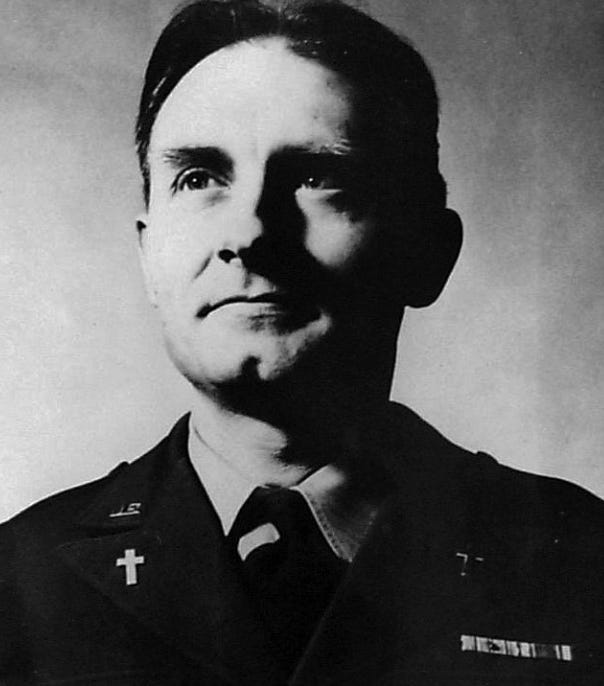
After the war, Kapaun attended graduate school, but then rejoined the Army as a chaplain. In 1949, he was assigned as a regimental chaplain in the 1st Cavalry Division, which was then on occupation duty in Japan. In July 1950, the division was sent to Korea as part of the US-led response to North Korea’s invasion of South Korea.
Kapaun served with his regiment on the front lines both in the Pusan Perimeter and during the subsequent breakout.
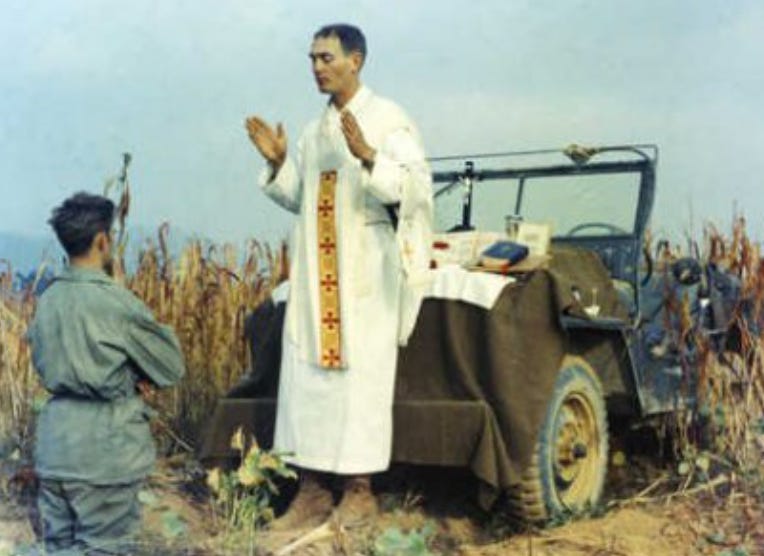
On November 1-2, 1950, Kapaun was with his regiment during the Battle of Unsan. His Medal of Honor citation explains what happened next:
For conspicuous gallantry and intrepidity at the risk of his life above and beyond the call of duty while serving with the 3d Battalion, 8th Cavalry Regiment, 1st Cavalry Division during combat operations against an armed enemy at Unsan, Korea, from November 1-2, 1950. On November 1, as Chinese Communist Forces viciously attacked friendly elements, Chaplain Kapaun calmly walked through withering enemy fire in order to provide comfort and medical aid to his comrades and rescue friendly wounded from no-man's land. Though the Americans successfully repelled the assault, they found themselves surrounded by the enemy. Facing annihilation, the able-bodied men were ordered to evacuate. However, Chaplain Kapaun, fully aware of his certain capture, elected to stay behind with the wounded. After the enemy succeeded in breaking through the defense in the early morning hours of November 2, Chaplain Kapaun continually made rounds, as hand-to-hand combat ensued. As Chinese Communist Forces approached the American position, Chaplain Kapaun noticed an injured Chinese officer amongst the wounded and convinced him to negotiate the safe surrender of the American Forces. Shortly after his capture, Chaplain Kapaun, with complete disregard for his personal safety and unwavering resolve, bravely pushed aside an enemy soldier preparing to execute Sergeant First Class Herbert A. Miller. Not only did Chaplain Kapaun's gallantry save the life of Sergeant Miller, but also his unparalleled courage and leadership inspired all those present, including those who might have otherwise fled in panic, to remain and fight the enemy until captured. Chaplain Kapaun's extraordinary heroism and selflessness, above and beyond the call of duty, are in keeping with the highest traditions of military service and reflect great credit upon himself, the 3d Battalion, 8th Cavalry Regiment, the 1st Cavalry Division, and the United States Army.
Although he had a chance to escape capture, Father Kaupan voluntarily remained behind with the wounded to minister to them.
His official Army biography explains that after his capture Father Kapaun continued to minister to his fellow prisoners:
Kapaun spent the next seven months in the Sambukol and Pyoktong prison camps, in what is now the Democratic People's Republic of Korea. With disregard for his own safety and comfort, Ch. Kapaun tended to the sick and wounded, scoured for food, built fires against guards' commands, and fashioned iron sheet vessels to launder the clothing of the wounded and purify drinking water. He also led prayers and spiritual services for the POWs, at the risk of punishment. For his outspoken resistance, Ch. Kapaun was feared by the guards and revered by his fellow POWs. Upon return, Pyoktong prison survivors told stories of Ch. Kapaun's courage, compassion, and spirit. They credited him with saving their lives, and hundreds more, before eventually succumbing to his own wounds and prison maltreatment.
Kapaun reportedly forgave the captors who took him away to die, offering them God’s blessings. Reportedly, he told his fellow prisoners “I’m going where I always wanted to go, and when I get there, I’ll say a prayer for all of you” and asked them to tell his bishop “I died a happy death.” He died of neglect in what was described as the camp’s death house.
In addition to the Medal of Honor, Kapaun was awarded the Distinguished Service Cross; Bronze Star Medal with "V" Device; Legion of Merit; Prisoner of War Medal; Asiatic-Pacific Campaign Medal with one Bronze Service Star for Central Burma Campaign; World War II Victory Medal; Army of Occupation Medal with Japan Clasp; Korean Service Medal with two Bronze Service Stars; National Defense Service Medal; and United Nations Service Medal, making him one of the most highly decorated Chaplains in the history of the US Army.
Kapaun was buried in a mass grave, but in 2021 his remains were identified and repatriated to the US. He was finally laid to rest in the Cathedral of the Immaculate Conception in Kansas City.
The Archdiocese for the Military has a nice webpage with information and videos relating to the finding of Kapaun’s remains and their internment.
The Cause of Father Kapaun
The Diocese of Wichita opened the requisite investigation and in 1993 John Paul II named Kapaun a Servant of God. In 2025, Kapaun was declared as Venerable by Pope Francis.
According to the website on his Cause, the Diocese has “received testimony of several instances of alleged miraculous intercession by Father Kapaun. Some of these potential miracles date back nearly two decades, while others occurred very recently. One or two will be sent in detail to the Dicastery for Saints in Rome for review by both theologians and medical experts before papal approval is given.”
The Call to Duty
Father Kapaun once wrote:
When I was ordained, I was determined to ‘spend myself’ for God. I was determined to do that cheerfully, no matter in what circumstances I would be placed or how hard a life I would be asked to lead.
I find that an incredibly inspiring call to duty. His life is an amazing example of the sort of heroic virtue to which we should all aspire.
The Prayer for Intercession
Father Kapaun, I ask your intercession not only for these needs which I mention now, [list them], but that I too may follow your example of service to God and my neighbor.
For the gifts of courage in battle and perseverance of faith, we give you thanks O Lord.
Then recite one Our Father, Hail Mary, and Glory Be.
Father John Hotze, Episcopal Delegate for Father Kapaun’s Cause, will be celebrating a novena of Masses the first 9 days of each month for those who have asked for Father Emil’s intercession. You can send your intention to the Cause via their website.
The Prayer for the Cause
Lord Jesus, in the midst of the folly of war, your servant, Chaplain Emil Kapaun, spent himself in total service to you on the battlefields and in the prison camps of Korea, until his death at the hands of his captors.
We now ask you, Lord Jesus, if it be your will, to make known to all the world the holiness of Chaplain Kapaun and the glory of his complete sacrifice for you by signs of miracles and peace.
In your name, Lord, we ask, for you are the source of peace, the strength of our service to others, and our final hope. Amen.
Venerable Emil Kapaun, pray for us!
Support the Cause
The Diocese collects offerings to support the dissemination of Father Kapaun’s story, the Cause, and his museum. I think it’s a very worthy cause (so to speak).
The process is set out in the Apostolic Constitution DIVINUS PERFECTIONIS MAGISTER, issued by Pope St. John Paul II in 1983.
The “cause” is the official canonical investigation to determine whether the candidate lived a life or heroic virtue or died a martyr to the faith.
Such prayers must be limited to private devotions, as Canon 1187 provides: “It is permitted to reverence through public veneration only those servants of God whom the authority of the Church has recorded in the list of the saints or the blessed.”