

I’ve been a fan of science fiction and fantasy as far back as I can remember. When it comes to science fiction, I’m mostly a Golden Age and New Wave guy. My favorites are authors like Robert Heinlein, Issac Asimov, Arthur C. Clark, Poul Anderson, Philip Jose Farmer, Gordon R. Dickson, Larry Niven, Jerry Pournelle, and so on.
Most modern science fiction leaves me unimpressed. The tropes are tired. Much of it is gloomy dystopian crap. Much of it is either pompous, politically correct posturing or, at the other extreme, MAGA politics with spaceships. There’s a lot of bad writing. Much of the bad writing is bad because it’s pretentious preening masquerading as high literature. Finding good stuff has gotten too hard because there’s so much self-published crap on Amazon it’s difficult to find the few gems. Editors and publishers did important gatekeeping work, but now there are no gatekeepers.
This has been true for a long time.
I’ve got a complete collection of Astounding/Analog science fiction magazines that starts in 1958 and ends in 1986. So I date my giving up on new science fiction to the mid-1980s.
To be sure, everything I just said is a generalization. There have been some exceptions. I recently reviewed the “final” Laundry Files novel by Charles Stross, for example, who is one of my two favorite modern science fiction writers.
The Regicide Report Brings The Laundry Files to a (Mostly) Satisfying Conclusion

When I first encountered Charles Stross’ work, I didn’t particularly want to like ir. Charlie, after all, is sort of a Trotskyite commie pinko neo-pagan or maybe something even worse.
The other member of that select group is John Scalzi.

Scalzi is a remarkably prolific author who has won multiple awards, including the John W. Campbell Award for Best New Writer and a Hugo Award for Redshirts. He has been anointed as the leader of The New Comprehensible movement.1
But it was not always so.
Old Man’s War
I still remember the first time I encountered Scalzi’s work. His publisher sent me an advance reader copy (ARC) of his first published novel, Old Man’s War (AMAZON LINK).2
It arrived at work on a workday. I started reading it at lunch and had to force myself to break away two hours later in order to get some work done. I was absolutely blown away; it literally was one of those “you can’t put it down” books. After gone for years without being excited by new science fiction, it was a source of great pleasure and excitement.
Old Man’s War is in the military science fiction genre, but it rose far above the usual crapola of that genre (see, e.g., David Drake). Indeed, I rank it right up there with Heinlein’s Starship Troopers (AMAZON LINK) and Haldeman’s The Forever War (AMAZON LINK) as one of the greatest military science fiction novels.
As the novel opens, John Perry has celebrated turning 75 in two deeply meaningful ways: paying his respects at his wife’s grave and then signing up for military service.
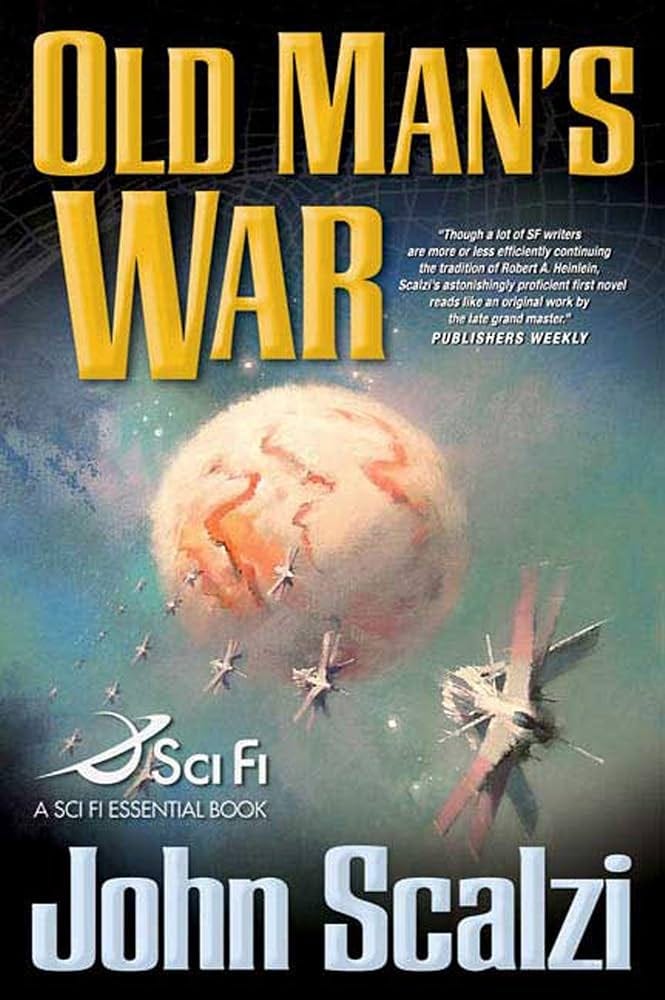
In the OMWverse, humanity has achieved its dream of reaching the stars, but the reality is sobering. Worlds capable of supporting human life are scarce and dangerous alien civilizations are everywhere. Space is a warzone and humanity must fight both to defend its home planet and to secure new places to live.
The conflict has ground on for years in far-flung corners of the galaxy—brutal, unrelenting, and without mercy. On Earth, the average person remains largely in the dark about it. The Colonial Defense Force (CDF) holds most of humanity’s military power and deliberately withholds the full picture. What is publicly known, however, is that older citizens can volunteer to serve. The CDF isn’t recruiting the young—it wants people who carry decades of wisdom and lived experience. Those who sign up leave Earth permanently, serve in the most dangerous theaters of war, and, if they survive, earn a piece of land on one of humanity’s new colony worlds. John Perry takes that deal, even with only a vague sense of what he’s getting into.
In tone, I suppose, Old Man’s War is closer to The Forever War than Starship Troopers. Scalzi’s tone suggests that he recognizes the necessity of fighting for the survival of the species (or whatever), while still deploring the stupidities of war. As Scalzi put it on his blog, in commenting on an Amazon reviewer (the then-ubiquitous Harriet Klausner) who claimed it was an anti-war novel:
I don’t know that I subscribe wholly to the book being anti-war. I would say that it is anti-stupid, in that at least of a couple of people acting stupidly in the performance of war reap the consequences of their actions. This also happens to be my general opinion of war: Use only when absolutely necessary; try not to use stupidly or wantonly; be prepared for the consequences.
Like Haldeman, moreover, Scalzi makes you care about the characters in a way that Heinlein didn’t bother with. Most of the major characters are eventually killed in action; each death pangs just a bit. All in all, if military sci-fi is even remotely your thing, and you haven’t read it yet, you need to buy this book.
Spreading the Word
There are authors one admires. Then there are authors one loves. And then there are those rare authors about whom one is compelled to be an evangelist. You just want to grab somebody by the collar, shove the book into their hands, and watch them get sucked in.
After reading Old Man’s War, Scalzi went to the top of that list.
I once referred to Scalzi (using the editorial we of which I am so very fond) as our favorite garrulous liberal science fiction writer (not to be confused with Charles Stross, our favorite garrulous socialist SF writer or Steven Brust our favorite not so garrulous Trotsykite fantasy writer).
As has been noted elsewhere, I was an early blogosphere Scalzi proselytizer:
The book was released in January of 2005, and bloggers had begun writing about it before it had even hit the shelves. Reynolds posted about the book first on November 22, 2004; Bainbridge posted about it on January 12, 2005, and Volokh on February 24, 2005. Scalzi said he believed the large number of online sales was a direct result of blogger-generated publicity.
Although Glen Reynolds of InstaPundit fame had reviewed it before I did, I was proud that my friend and former UCLAW colleague Eugene Volokh credited me along with Glen for getting him interested in it:
Just finished John Scalzi’s Old Man’s War, which was very good. I bought it in hardcover; cheapskate that I am, I rarely do this except with authors whose work I know well, but I made an exception because of Instapundit’s and Professor Bainbridge’s recommendations. They steered me well; really good science fiction, fresh and well-crafted.
Oddly, the weakest parts of the book are the first few chapters, which weren’t quite as tightly written as the rest of the book. If you find yourself disappointed at first, stick with it; I think you won’t be disappointed.
Candidly, I disagreed back then (and still do) with Eugene about those first few chapters. I was hooked from page one.
Ghost Brigades
I received an ARC of Ghost Brigades (AMAZON LINK) in January 2006.3 I started it late in the evening on the day it arrived and barely managed to tear myself away at midnight to go to bed. I polished it off the next day over a long lunch.
I liked it even better than Old Man’s War.
![The Ghost Brigades [Book]](https://substackcdn.com/image/fetch/$s_!ZO93!,f_auto,q_auto:good,fl_progressive:steep/https%3A%2F%2Fsubstack-post-media.s3.amazonaws.com%2Fpublic%2Fimages%2Fb09ac10a-736c-4fe1-bd7a-48fca3848a4b_1120x1120.jpeg "The Ghost Brigades [Book]")
The Ghost Brigades takes place in the same universe as did Old Man’s War, but unlike so much modern series science fiction and fantasy it can be read as a stand-alone.
The Ghost Brigades serve as the Colonial Defense Forces’ (CDF) elite special operations units—soldiers cloned and genetically engineered from the genetic material of deceased individuals. They are optimized for the CDF’s most demanding missions. Physically superior and unburdened by ordinary human moral qualms and hesitation, they represent humanity’s sharpest military edge. The tip of the spear.
That spear is about to be tested severely. Three alien species, each of which had previously tangled with the CDF, have formed a coalition aimed at stopping human expansion into space. Central to their strategy is a rogue CDF scientist, Charles Boutin, who has handed humanity’s most sensitive secrets to the enemy. To counter this threat, the CDF needs to understand what drove Boutin to betray his own kind.
Their best hope is Jared Dirac. Dirac was cloned and genetically engineered using Boutin’s own DNA. Dirac’s mind was designed to unlock and access Boutin’s stored digital memories. Unfortunately, the procedure seemingly failed. So, rarther than waste high quality material, Dirac is assigned to the Ghost Brigades, where he proves to be an exemplary soldier. Gradually, however, fragments of Boutin’s memories begin to emerge, giving Dirac unsettling insight into the motivations behind the betrayal.
Dirac eventually finds himself on a desperate search for the man whose DNA he carries—a hunt that forces him to wrestle with profound questions about his own identity and the choices he must make. The clock is ticking: the alien alliance is mobilizing for an assault, and their ambitions extend well beyond simply defeating humanity on the battlefield.
In Ghost Brigades, Scalzi answers some key questions about his universe that bugged me after Old Man’s War; most notably, why does the CDF need both regular soldiers and the Special Forces? His explanation is pretty much consistent with my best guess and makes total sense. {No spoilers} In addition, however, Scalzi begins to explore some of the deep philosophical questions raised in Old Man’s War: Do clones have souls? What’s the difference between consciousness and the soul? To what extent can society ethically use clones for its own purpose; put another way, are clones proper subjects of the Kantian imperative?
Despite his failure to properly use the Oxford comma, presumably a consequence of his misspent years in journalism, Scalzi is a brilliant writer. His prose sparkles with life and action. His plots are fast-paced, plausible within the parameters of the universe he’s created, and rarely predictable. What especially impresses me, however, is Scalzi’s insights into human nature. So many science fiction and fantasy writers these days seem to lack insight into human nature. As a result, their novels are really travelogues populated by cardboard cut-outs. In contrast, Scalzi spends very little time on scenery, but instead focuses on developing a plausible society peopled by fully realized characters. It’s great stuff.
I Got A Scalzi Shout Out
In Jeeves and the Feudal Spirit (AMAZON LINK), one of P.G. Wodehouse’s wonderful Jeeves and Wooster novels, the narrator Bertie Wooster opines:
I mean, while one lives for one’s Art, so to speak, and cares little for the public’s praise or blame and all that sort of thing, one can always do with something to paste into one’s scrapbook, can one not?
Words to live by.
So, I was surprised, honored, and pleased to get a shout out from Scalzi in the acknowledgements section to Ghost Brigades (AMAZON LINK), which was Old Man’s War’s sequel:
One of the reasons that the Ghost Brigades exists is that the first book in the series, Old Man’s War, was fortunate enough to have been praised online by folks whose taste in books is trusted by their readers. I thank all of them and add special thanks to Glenn Reynolds, Cory Doctorow, Stephen Green, Stephen Bainbridge and Eugene Volokh.
Conclusion
Future parts (I’m not sure how many at this point) will move us forward to Scalzi’s most recent entry in the OMWverse.
Scalzi has explained that he writes with a real person in mind; namely, his mother in law:
She's your pretty much the average American in all respects and downs Nora Roberts and Julie Garwood books like they're going out of style. I write my novels so that when she sits down to read them she's able to follow what's going on and doesn't feel like she's missing scads of context. My mother-in-law is not my primary audience; I'm not writing for her. But by keeping her in mind when I write, I don't exclude her, and by extension I don't exclude lots of other readers like her.
I don’t read Nora Roberts and I have no idea who Julie Garwood is, but I think there is an underappreciated audience for books where you can follow along without getting a headache.
This was back in 2005 when blogging was young-ish and my blog www.ProfessorBainbridge.com was fairly widely read. Back then book reviews were a big part of my output, so I got a fair number of ARCs
Sadly, these days, I have to pay for my copies. Still, it’s money well spent.