

This summer I’ve been rereading Father Berard L. Marthaler’s wonderful book, The Creed: The Apostolic Faith in Contemporary Theology (AMAZON LINK), which offers a comprehensive study of the Apostles’ and the Nicene Creeds, which are the Christian Church’s foundational statements of belief. I’ve been cross-referencing Bishop Robert Barron’s study of the Nicene Creed, Light from Light (AMAZON LINK), which is a little more dense.


We know what we believe, so why the need to recite it every Sunday?
Malcolm Gladwell famously said that to master something, you must do it 10,000 times. (More, precisely, he said you must practice it for 10,000 hours.) Repeating the Creed every week is like practicing an instrument regularly, It helps us internalize the Creed and to make it as natural a part of life as playing the instrument. It becomes part of the muscle memory of our faith.
Why is it important for the Church to be able to point to scripture to back up the Creed?
Here’s a common Protestant take on Catholic beliefs:
… official Catholic doctrine is so far removed from biblical moorings the Catholic Church cannot be a true church. …
Because the Catholic Church has rejected fundamental Biblical doctrines such as justification, by faith alone, worshiping and praying to God alone, Christ as the head of the Church, and Christ’s sacrifice for all sins of his people, I believe the Catholic Church is a false church.
But Catholics in fact believe that Scripture is the divinely inspired word of God. While the Church teaches that God’s revelation did not end when the canonical order and content of the New Testament were finalized, no statement of faith or belief that is contrary to the Scripture can be regarded as truly orthodox. It is the touchstone against which our beliefs are measured.
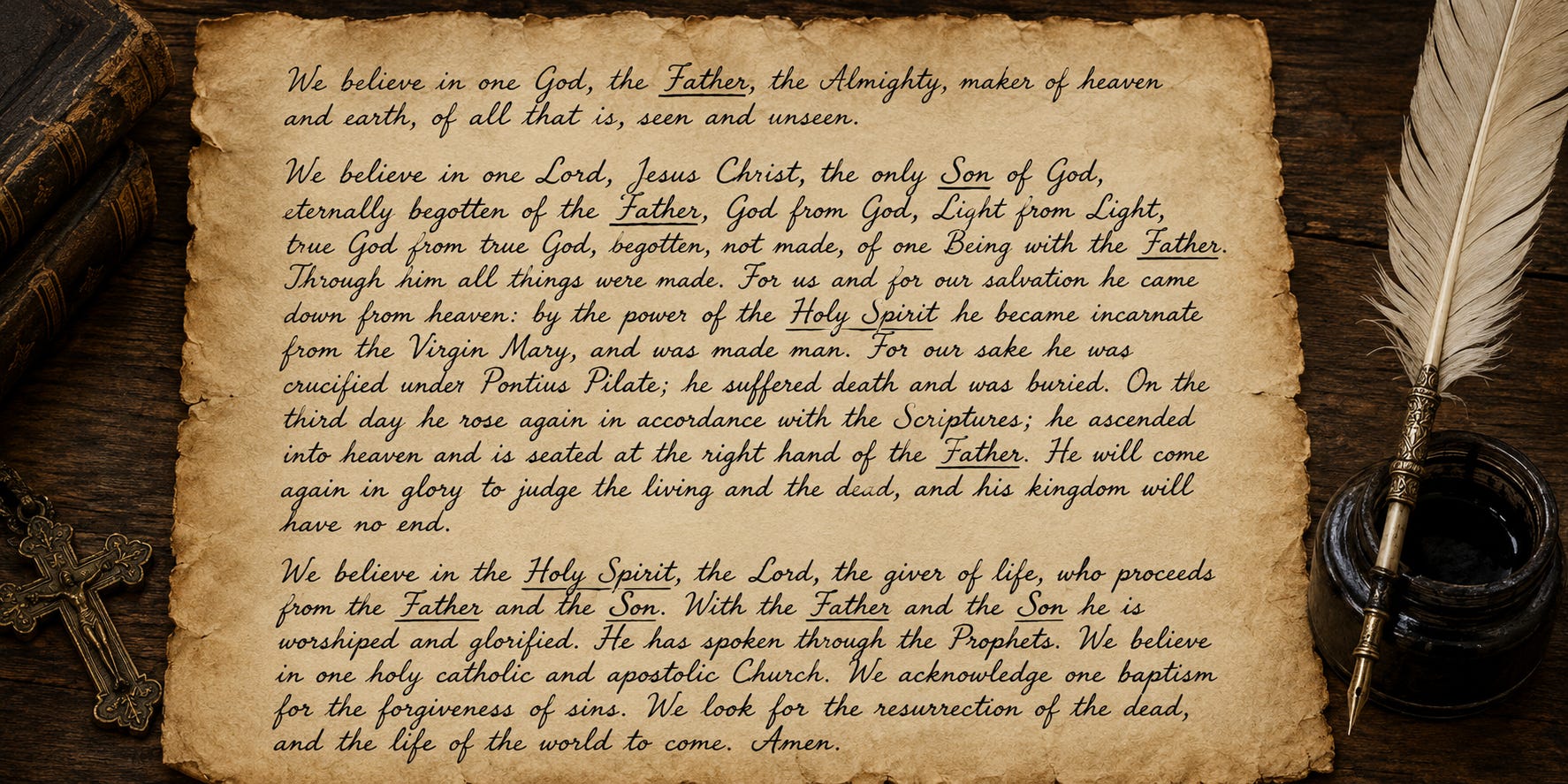
What is the difference between the Nicene and Apostles Creeds?
There are some important differences between the two Creeds:
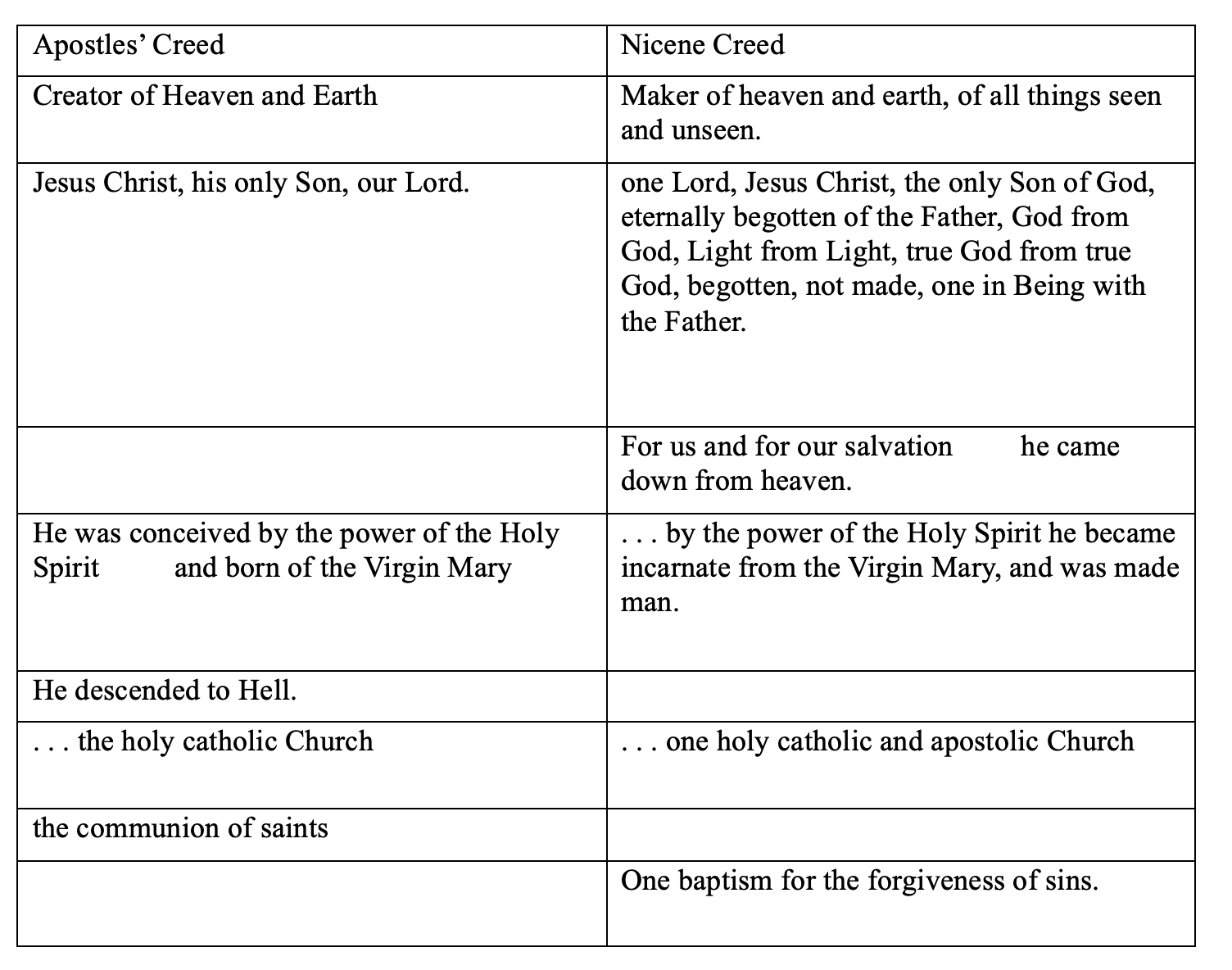
As Marthaler relates (83ff), the additional language in the Nicene Creed does not reflect a change in doctrine but rather a rejection of heresy. The authors of the Nicene Creed elaborated the Church’s theology of the Trinity and the Godhead by making it more precise, albeit at the cost of complexity. “Begotten of the father” rebuts the heresy that claimed there was only one God with three names or modalities. “God from God” affirms that Christ’s nature was fully divine, as does the statement that Christ was “begotten not made,” which reaffirms that he is God and not a creature. “Became man” confirms that Jesus was also fully human, while simultaneously being fully divine.
Hence, it seems to me that the Apostles’ Creed likely an earlier creed that was largely settled before the controversies to which the Nicene Creed is addressed.1 The Apostles’ Creed lacks the developed theology—especially the more fully developed Christology—that is present in the Nicene Creed. As a result, Unitarians accept the Apostles’ Creed because of its lack of an explicit Trinitarian statement. Likewise, Arians (if there are still any) can accept the Apostles’ Creed because of that absence.
Marthaler explains that “The Apostle’s Creed came to have more of a pedagogical than a liturgical function.” Given that we use the Apostles’ Creed in the liturgy part for the liturgical year,2 I initially found this unenlightening. On further examination, however, I take his point. The Nicene Creed functions as a detailed test of orthodoxy, while the Apostle’s Creed is better suited for teaching new converts and the young, because it gets across the basics without getting to deeply into into the complex mysteries of the Trinity.
The dating of the Apostles’ Creed is uncertain. Many scholars trace its present form to Southwestern Gaul in the 8th Century. On the other hand, it seems to be based on the 2nd Century Old Roman Creed.
The Roman Missal permits priests to use the Apostles' Creed instead of the Nicene Creed during the Mass, especially during Lent and Easter seasons. In addition, the Apostles’ Creed is used in the following liturgical situations:
Baptisms: Used in an interactive question-and-answer format for both infants and adults. It is also used during the renewal of baptismal promises at Easter and Confirmations.
The Rosary: Recited as the opening profession of faith on the crucifix before beginning the decades.
Liturgy of the Hours: Frequently used during Morning and Evening Prayer within certain Catholic traditions (like the Ordinariate).