As mentioned in an earlier post, I’m rereading Father Berard L. Marthaler’s magisterial work The Creed: The Apostolic Faith in Contemporary Theology (AMAZON LINK):
Father Berard L. Marthaler (1927-2014) was a professed member of the Louisville Province (Our Lady of Consolation) of the Order of Friars Minor Conventual (OFM Conv.). He was received a S.T.D. (Doctor of Sacred Theology) from the Pontificia Facoltá di S. Bonaventure in Rome. He then earned a Ph.D. in history from the University of Minnesota. He taught a…
The last post was an introduction to Marthaler and the work.
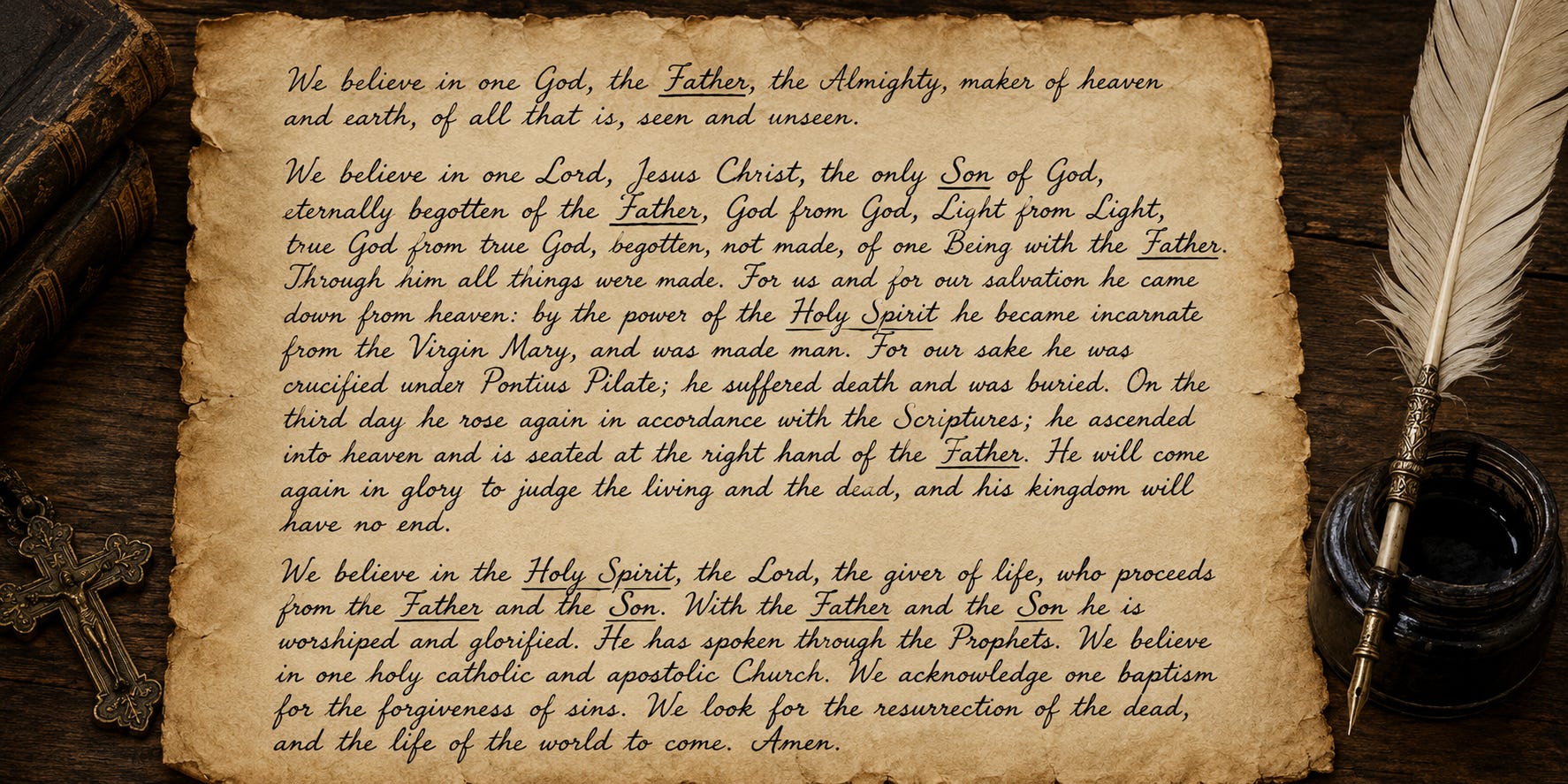
This post focuses on the Trinitarian1 terminology in the Creed:
We believe in one God, the Father almighty …
And in one Lord Jesus Christ, the only Son of God …
And we believe in the Holy Spirit, the Lord, the giver of life.
Some theologians and believers in general prefer to speak of the Triune God using the names, “Creator, Redeemer and Sanctifier” rather than the traditional names of “Father, Son and Holy Spirit.” The fact that the usage tends to be more common in progressive, mainline Protestant denominations leads many to assume that the nomenclature is a modern attempt to use gender-neutral, inclusive language. As one Episcopalian source observes, for example:
This formulation is—as far as I know—a construct of liberal protestant theology without particularly deep roots in Christian practice, especially in the ways it’s coming more and more into use.
Marthaler similarly observes that “some (many?) … feel that the father-figure has been used as a justification of the hierarchical organization of society and the source of many inequalities.” (44)
In fact, however, there is some evidence for a far earlier origin. One commentator traces it to the (unratified) 1689 Anglican Book of Common Prayer, for example.2
Yet, even if it is not a modern politically correct neologism, I am not convinced that the “Creator, Redeemer and Sanctifier” terminology is an improvement on the traditional “Father, Son, and Holy Spirit.” To the contrary, I think there are two serious problems with that formulation.
Scriptural Warrant
Granted, it is obviously desirable for the Church to be all-inclusive, so that all may be saved. Also granted, it is true that God “is neither male nor female” in a literal sense. (43)3
Nevertheless, it is not obvious (at least to me) that non-gendered language is appropriate when speaking the Triune God. The historical Jesus, after all, was indisputably male. At Jesus’ baptism by John, God spoke from Heaven, naming Jesus as “my Son.” Conversely, Jesus refers to God as “Abba” or Father. According to Marthaler, he does so 170 times in the NT. (42) So too do the writings of the New Testament and the early Church fathers.
The Catechism explains that:
By calling God “Father”, the language of faith indicates two main things: that God is the first origin of everything and transcendent authority; and that he is at the same time goodness and loving care for all his children. (¶ 239)
As the Catechism goes on to emphasize, of course, this does not exclude the important role of women in the Church nor does it gender God: “He is neither man nor woman: he is God.” Instead, as Marthaler suggests, this usage reflects the fact that we attribute to God “those ideal qualities we associate with fatherhood: the giving of life, love, faithfulness, continued care and protection, and wisdom that guides and instructs. (43)
Creator, Redeemer and Sustainer don’t work. They are about what God does not who God is. They are about operations not ontology.
… “‘Creator,’ ‘redeemer,’ ‘sustainer’ are operational or economic names. But trinitarian language is ontological language. It is the language of God’s being, not of God’s doing.”
The actions of God, outside of himself (ad extra), are common to all three persons. The Trinity creates. Therefore, the action of creation is common to all three persons, the Father, Son, and Holy Spirit. Whenever we describe the action of one person of the Trinity, such as the work of the Holy Spirit at Pentecost, the other persons are always there. Pentecost is as much the action of the Father and the Son as it is of the Holy Spirit.
Accordingly, the commentator argues:
… to baptize in the name of the “Creator, Redeemer, and Sanctifier,” as opposed to the “Father, Son, and Holy Spirit” is to do one of two things:
Imply that there are three gods: one is the creator god, another is the redeemer god, and the other one is the sanctifying god. [Or]
Imply that the one person acts in three different modes, that God is acting as creator, then as redeemer, then as sanctifier.
Both of which are heretical denials of the Trinitarian creed.
StephenBainbridge.com is a reader-supported publication. To receive new posts and support my work, consider becoming a free or paid subscriber.
Thanks for reading StephenBainbridge.com! This post is public so feel free to share it.
I have always liked C.S. Lewis’s description of the Trinitarian faith in Mere Christianity (AMAZON LINK). He suggested that humans lack the language to truly understand that Trinity, but then offered a wonderful and helpful analogy that was probably based on Edwin Abbott’s Flatland. Joel Anderson summarizes it as follows:
On a one-dimensional level, you can have a straight line. On a two-dimensional level, those lines can be combined in ways they couldn’t conceive in a one-dimensional world, and they could form a square. Moving on, on a three-dimensional level, those squares can be combined in yet more inconceivable ways for anyone living in a one-or-two-dimensional world, and could form a cube. …
Lewis, though, suggests that the doctrine of the Trinity describes a “higher kind of life,” where you can have “a being who is three Persons while remaining one Being, just as a cube is six squares while remaining one cube.” Let’s face it, if you were a square, and someone tried to tell you about the reality of a cube, that person might be able to draw something like this, but what you’re looking at isn’t really a cube: it’s a two-dimensional illustrate of what a cube would look like. We get a general idea, but unless you step into a three-dimensional world, that drawing will still be beyond our understanding. …
Trying to get your head around Trinitarian life is going to be a futile endeavor: you never will, fully. But you can “know” it on a relational level, through others who are trying to do the same. Is it a difficult concept? Of course. But Christian doctrine isn’t going to be easy. As Lewis states, “We cannot compete, in simplicity, with people who are inventing religions. How could we? We are dealing with Fact. Of course anyone can be simple if he has not facts to bother about.”
For me, that’s one of the most intriguing things about Christianity: it’s quirky, and it’s hard to really grasp with my intellect alone. But what is points to can be seen in a thousand different ways in real life.
I find his line of argument somewhat dubious. First, the 1689 edition was never approved by the Anglican Church, leaving its authority somewhat questionable. Second, notice that the actual text includes the traditional Father, Son, and Holy Spirit formulation:
O GOD the Father, Creator of heaven and earth : have mercy upon us miserable sinners. O God the Son, Redeemer of the world : have mercy upon us miserable sinners. O God the Holy Ghost, our Sanctifier and Comforter : have mercy upon us miserable sinners.