

Judge Richard A. Posner passed away about two weeks ago. The NY Times obituary reports that:
Judge Posner, who served from 1981 to 2017 on the United States Court of Appeals for the Seventh Circuit, in Chicago, wrote thousands of judicial opinions and more than 50 books on a vast array of topics, along with countless scholarly articles, essays, book reviews and blog posts. …
Only two other American judges who did not serve on the Supreme Court had his stature: Judges Learned Hand and Henry J. Friendly, who both sat on the federal appeals court in New York.
I got to thinking about Posner when I saw this post on X today:
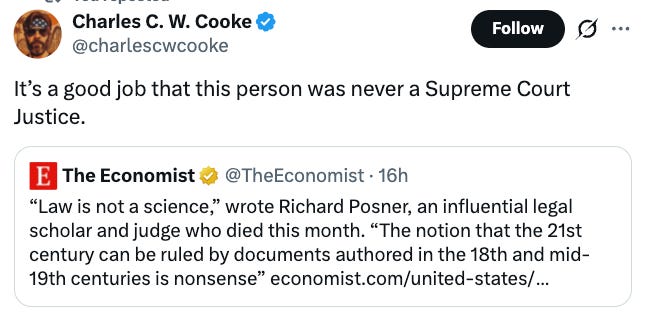
I confess to agreeing. Back in 2003, when there were rumors that Bush 43 was considering appointing Posner to the Supreme Court I wrote that: Russell Kirk’s classic canons of conservative thought include six elements: (1) belief in a transcendent order and natural law; (2) rejection of egalitarianism and utilitarianism; (3) support for class and order; (4) belief in the linkage between freedom and private property; (5) faith in prescription and custom; and (6) recognition that change is not necessarily salutary reform. As I read his body of work, Posner clearly fails 1 and 2, and likely fails 3 and 5. The only one I’m sure he passes is #4.
I’m not going to bother defending those claims at this point, because Posner himself rejected the conservative label, calling himself a pragmatic classical liberal. Richard A. Posner, Overcoming Law 23 (1995). For those interested in pursuing the disconnect between Posner’s jurisprudence and the strand of conservatism that comes down to us from Burke via Russell Kirk, however, I recommend James G. Wilson’s article Justice Diffused: A Comparison of Edmund Burke’s Conservatism with the Views of Five Conservative, Academic Judges, 40 U. Miami L. Rev. 913 (1986), and Ernest Young’s article Rediscovering Conservatism: Burkean Political Theory and Constitutional Interpretation, 72 N.C. L. Rev. 619 (1994) (same).
Indeed, it seems safe to say that Posner would have ended up aligned with the left-wing block on the Court. After all, Posner publicly distanced himself from the Republican Party in his later years on the bench, acknowledging in a 2012 interview that he had become less of a conservative.
As somebody whose legal views are shaped by Burkean conservatism, I firmly believe we dodged a bullet when Posner was passed over. If a Republican had put him on the bench we would have suffered the same sort of disappointments GOP Presidents suffered with appointments like Earl Warren, John Paul Stevens, or David Souter. Except that Posner was a lot smarter than those three, which made him even more dangerous.
Posner on Catholicism
It’s appropriate that I’m writing this post on Christ the King Sunday. As someone who strives to put his faith ahead of his politics, I was routinely appalled by Posner’s attitude towards religion.
As discussed in an earlier post, Posner’s commentary on Catholic teaching on contraception was “interesting, provocative, and a little sloppy.”

The post was based on a 2010 post from my old blog: Posner Instructs Catholics on Contraception.
Also, in 2010, I wrote a post More Posner Sloppiness re Catholicism, in which I mocked his claim that “The Roman Catholic Church is a huge ‘corporation. …’”
I concluded:
I find Posner’s sloppiness in this case amusing, because in his book Public Intellectuals he blasted public intellectuals for often doing sloppy work, which he called “little better than kibitzing” and which he said evidences “only a superficial engagement with the facts.” Pot meet Kettle.
Yet, it’s also troubling. Posner is a respected public intellectual, who musing are widely read. Yet, as Robert Araujo notes, Posner “offers little evidence demonstrating that he really understands religion, in general, and Catholicism, in particular.” Regrettably, the uninformed reader may give Posner’s ill-informed musing far more credence than they deserve.
Finally, it’s worth pondering whether Posner’s sloppiness reflects an underlying hostility. Posner once dismissed Catholic philosopher John Finnis’ views of homosexuality as being “incomprehensible to the secular mind.” (The Problematics Of Moral and Legal Theory at 76) Likewise, Posner dismissed the public square as a forum for social deliberation because it is tainted by religion: “Since so many Americans . . . are religious, and religious belief is a showstopper so far as public debate in our society is concerned, it is doubtful that deliberation over fundamental political goals and values is feasible outside our leading universities, the ethos of which is secular.”(Law, Pragmatism, and Democracy at 137) And then there’s his claim that “[t]he combination in the United States of an extraordinarily high crime rate with an extraordinary degree of allegiance to Christian beliefs must make one question the pacifying effects of Christian zeal.” (Sex and Reason at 235-36) These are not the words of someone friendly towards Catholicism or even of someone who is merely neutral.
In his essay Overcoming Posner (94 Mich. L. Rev. 1898), my former colleague Gerard Bradley complained of “Posner’s recurring caricaturization of the Catholic Church when he should be engaging in counterarguments.” Gerry also notes that “Posner squarely invites the reader to choose between religion ... and reality.” Finally, Gerry catches Posner in yet another example of sloppiness with facts. Posner wrote that “Cardinal Bellarmine refused to look through Galileo’s telescope at the moons of Jupiter, whose existence seemed to refute the orthodox view that the planets were fixed to the surface of crystalline spheres ....” As Gerry points out, however, “Posner is grotesquely wrong on the facts here. Bellarmine, a leading theologian of the day, was on friendly terms with Galileo. Bellarmine accepted Galileo’s invitation to look through the telescope in April of 1611, and thanked Galileo for the opportunity.” Yes, Galileo eventually got into trouble with the Church, but here again we see Posner evidencing “only a superficial engagement with the facts.”
One wonders why Catholicism seems so often to be the victim of “a superficial engagement with the facts” in Posner’s musings.
Posner’s hostility to Catholicism likely played a role in his controversial decision in University of Notre Dame v. Sebelius, which denied Notre Dame religious exemption from Obamacare’s contraception mandate.1
Judge Posner demonstrated some fairly strong views about the Catholic Church’s position on contraception—as an authoritarian Church seeking to impose its views on its followers. Posner’s feelings on the subject seemed to manifest themselves in the tone and types of questions put by Posner to Kairis during the oral argument in the Notre Dame case. These views and the manner in which Posner posed questions to Kairis seem to indicate confirmation bias. … Not surprisingly, Judge Posner ruled against Notre Dame in this case. His previous designation of the Catholic Church as an authoritarian church afraid of losing its moral authority regarding the issue of contraception may indicate a form of confirmation bias on this issue as manifested in the content and tone of his questions to Kairis.2
Conclusion
The New York Times obituary notes that Posner “wrote with self-confidence and authority, qualities his critics said were not always entirely deserved.” Those qualities led him to be sloppy, dismissive of others’ views, and largely unprincipled.
Unprincipled? The Times also notes that Posner “called his approach to judging pragmatic. His critics called it lawless. ‘I pay very little attention to legal rules, statutes, constitutional provisions,” Judge Posner said in a 2017 interview.” So, yes. Unprincipled.
743 F.3d 547 (2014), cert. granted, vacated sub nom U. of Notre Dame v. Burwell, 135 S. Ct. 1528 (2015).
Christine M. Venter, The Case Against Oral Argument the Effects of Confirmation Bias on the Outcome of Selected Cases in the Seventh Circuit Court of Appeals, 14 Legal Comm. & Rhetoric: JALWD 45, 64–65 (2017).