

Matthew Yglesias’ latest Substack post argues:
… we need to treat electricity generation as a platform for broader growth and not just an item in the household consumption budget. …
Most Democrats would tell you that … they have a vision of the world in which we electrify home heat, get people using electric cars (and eventually trucks), and welcome a renaissance of American manufacturing. Setting data centers and A.I. entirely to the side for a moment, that’s a vision that inherently involves producing and consuming a lot more electricity. …
If you need a lot more electricity, then planning for new generation investments and new transmission is really important. And across most of the country the regulatory paradigm isn’t set up to do that.
It’s a typically interesting analysis of the regulatory and political issues, but I want to use it as a jumping off point to revisit a subject I tackled years ago on my old blog; namely, why not leverage our Navy’s expertise with small nuclear reactors.
I agree with something Andrew Sullivan (who has very kindly become a paid subscriber to my little journal1) said back in 2010 in commenting on President Obama’s State of the Union address:
There’s no way to tackle our carbon addiction without nuclear energy as part of the solution.
Commenting on that same speech Bradford Plumer wrote:
Guess Obama wasn't kidding when he gave all those shout-outs to nuclear power in his State of the Union address on Wednesday. According to Bloomberg, Obama's 2011 budget will request $54 billion in loan guarantees for new nuclear reactors—triple the previous amount. …
And the case against comes from the Union of Concerned Scientists, which argues that big nuclear projects have historically been very risky—prone to delays and cost overruns—and that the default rate on these loans can be quite high, sticking taxpayers with the bill. Instead, says UCS, it'd be better to direct that money toward cheaper, more reliable options for reducing emissions—efficiency or waste-heat capture or even wind power.
All of which got me to thinking.
Almost since its founding, the Army Corps of Engineers has had a major domestic, peace-time function in civilian civil works projects. So there is a precedent for having the military run such projects.
The Navy already operates dozens of small nuclear reactors in aircraft carriers and submarines, with an outstanding record of safety and reliability. They have an established training program that churns out nuclear-capable officers.

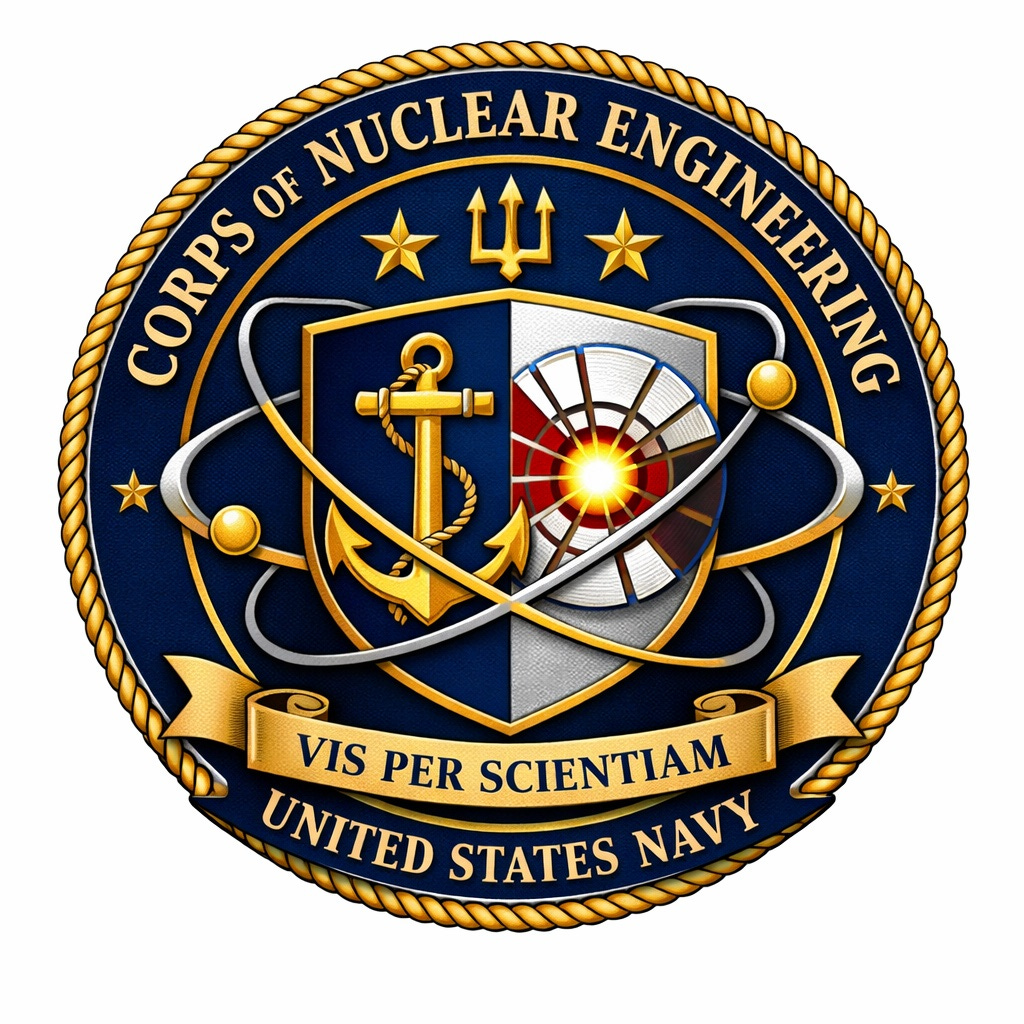
By analogy to the Army Corps of Engineering, we could create a Navy Corps of Nuclear Engineering. It would build and operate dozens of small nuclear power plants around the country. To address security concerns, the first plants would be built on military bases, where the garrison can provide security. Licensing costs would be cut because the government would own and operate the plants.
The proposal should not offend small government sensibilities. Nuclear power is rife with market failures (and government failures). Huge research and development costs associated with traditional large scale nuclear power plants may be beyond the ability of private firms to finance. In addition, we know that private firms tend to underproduce the sort of basic R&D necessary to develop new generations of power plants. But the Navy already spends money to develop new naval reactors, which presumably could be scaled up at reasonable costs. Since the Navy need not worry about earning market competitive rates of return on its investment in R&D, moreover, there’s no economic disincentive to conducting that sort of R&D in the Navy.
Private utilities are subject to state utility regulators who notoriously meddle, typically to “protect” consumers from rate increases, but usually with the outcome of making plants nonprofitable. A federal Naval Corps of Nuclear Engineering presumably would be outside the scope of state regulation.
Private utilities used cost-plus contracting when building nuclear power plants—with all its notorious problems—because there were serious problems of incomplete information when dealing with large scale, non-standardized plants. Smaller, standardized plants should be amenable to fixed price contracts.
Private parties have a hard time adequately insuring against very low probability but very high magnitude events. Since the taxpayer likely would ultimately be on the hook anyway, why not have the government own the plant and self-insure? And profit from selling electricity?
Another advantage of my proposal is that lots of military bases are brownfield sites that would require mega-investments in environmental cleanup before being converted to civilian use. So why not build a nuclear plant there?
Granted, if you go to a commercial nuclear plant, you will find it staffed with [wait for it] Navy veterans. I used to have a friend who was a nuclear engineer on an aircraft carrier whose plan was to do his 20 and get out so as to double dip with a high-paying job with a private sector. But the Army Corps of Engineers figures out ways to deal with staffing and retention. So why can’t the navy?
My proposal makes even more sense today. The U.S. military is already working on small, mobile 5 MW nuclear reactors to power expeditionary bases. The Army’s Janus Project “aims to deliver secure, resilient, and reliable energy to support national defense installations and critical missions.” Just this month, an Air Force C-17 airlifted a mini-reactor from California to Utah.
I’ll even donate a mockup of their insignia:
By the Way
You may recall my recent post on Pareto efficiency and AI disruptions:
Taxing AI

I’ve been a science fiction fan almost since I started reading and watching TV and movies. So I grew up with sentient computer antagonists like Colossus, Hal 9000, Skynet, and AM.
I’ve got a new post over at BainbridgeOnCorporations.com, my corporate law and governance Substack that deals with the stock market’s ability to price AI disruptions:

This Substack will remain free. But donations are welcome.