

In the preceding post, I looked back to the moment in 2006 when I received an advance reader copy (ARC) of John Scalzi’s first novel, Old Man’s War.
Two Decades as a John Scalzi Fan: Part 1

I’ve been a fan of science fiction and fantasy as far back as I can remember. When it comes to science fiction, I’m mostly a Golden Age and New Wave guy. My favorites are authors like Robert Heinlein, Issac Asimov, Arthur C. Clark, Poul Anderson, Philip Jose Farmer, Gordon R. Dickson, Larry Niven, Jerry Pournelle, and so on.
The Sagan Diary
In February 2007, I bought signed and numbered (191/400) copy of John Scalzi’s The Sagan Diary (AMAZON LINK). Along with a good cigar and a glass or three of port, it made a great after-dinner treat. The Sagan Diary differs radically from Scalzi’s other published works. Unlike the earlier Old Man’s War novels, in whose universe The Diary is located, this is not a military sci-fi action tale. Unlike the very funny and entertaining stand-alone novel, The Android’s Dream (AMAZON LINK), The Diary doesn’t start with a chapter-long fart joke.
Instead, it is an introspective rumination on life, love, and words. Indeed, the first half might fairly be called a great writer’s (prose) song about his love for words. The second half is a moving prose Valentine, in which Scalzi’s Sagan ruminates on the experience of loving another.
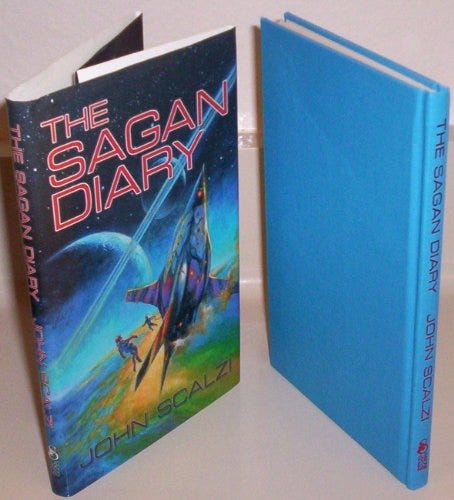
The Diary showed an emotional depth at which Scalzi’s prior work only hinted. It proved that this was—as he still is—a writer in whom one ought to invest for the long haul, as it suggested that he has only scratched the surface of his potential.
In addition, it gave us an alternative viewpoint on some of the best scenes in the earlier novels and also filled in some gaps that had gone unexplored.
I also got a nice shout out from Scalzi for an earlier review:
Steven Bainbridge1 has nice things to say about “The Sagan Diary” …. I am pleased with the former review because it’s really the first one I’ve seen of “Sagan,” and Professor Bainbridge has been an avid reader of the previous work, so I’m happy to see “Sagan” works for him ….
The Last Colony
Shortly after my copy of The Diary arrived, I received an ARC of The Last Colony (AMAZON LINK). I sat down with at lunch after teaching that day’s class, telling myself I’d just read a few pages, and lost the rest of the work day. (More than once, a new John Scalzi book has done terrible things to my productivity.)
It brought to an immensely satisfying conclusion—albeit only temporarily as it turns out—the trilogy that began with Old Man’s War.
Scalzi returns to John Perry as the POV character, but this time in a story that’s more political mystery than military sci fi.
Perry and his wife, former Colonial Defense Force (CDF) Special Forces warrior Jane Sagan, are now retired from the CDF and his consciousness has been transferred from the supersoldier body he had as a CDF soldier into a more or less human norm one.
Perry is a farmer and village ombudsman for a human colony on a new-ish human colony planet named Huckleberry. But the Colonial Union (CU) prevails on Perry and Sagan to lead a new colony, Roanoke, which will be colonized by representatives of all the major human planets.
It gradually becomes apparent that the CDF has an undisclosed political plan, which plunges Perry and Sagan back into the world(s) of interstellar politics and war. Perry and Sagan’s efforts to figure out the CU’s secret plans is the main storyline.
Perry’s solution to his political problems has considerable elegance, as does Scalzi’s plotting and writing. (No hack writer he.) The pace is quick, and the plot is taut. There aren’t a lot of subplots and most of them end up being essential. (There’s one subplot involving spears whose purpose I never quite figured out and about which I won’t say more for risk of offering spoilers. But if you’ve read it, maybe you can explain to me whether that story line is anything more than local color.)
Do you have to have read the first two books in the series for TLC to make sense? No:
John Scalzi has styled this novel to stand well on it’s own. The book starts with great humor that brings the reader into the story easily and comfortably. You never get the feeling that your starting from the back of the series. John gives you two pages of intro in John Perry’s universe and then blasts off.
Having said that, however, you’d be missing a real treat. If you haven’t already read the first two novels, grab them too and then set aside a couple of days to immerse yourself.
Back to The New Comprehensible
In the previous post, I noted that an SF reviewer once dubbed Scalzi the leader of The New Comprehensible movement.
Around that time, Scalzi was writing passionately about the need for science fiction to become less insular:
... if you look at the significant SF books of the last several years, there aren’t very many you <em>could</em> give to the uninitiated reader; they all pretty much implicitly or explicitly assume you’ve been keeping up with the genre, because the writers themselves have. The SF literary community is like a boarding school; we’re all up to our armpits in each other’s business, literary and otherwise (and then there’s the sodomy. But let’s not go there).
... Fantasy literature has numerous open doors for the casual reader. How many does SF literature have? More importantly, how many is SF perceived to have? Any honest follower of the genre has to admit the answers are “few” and “even fewer than that,” respectively. The most accessible SF we have today is stuff that was written decades ago by people who are now dead.
I agreed with Scalzi back then and I still do. Most modern SF is either PC crap or MAGA military SF excrement. This is why I’ve got a collection of Astounding/Analog magazines that ends in 1986.
Thanks to numerous horrifying lunchroom experiences growing up, SF geeks like me are probably perfectly happy to be let alone with their genre and to let the mundanes read whatever appalling romantasy and/or Da Vinci Code clone they're slobbering over this week.2 But not Scalzi. Instead, he's been writing immensely accessible novels all along.
Making this point back in the day got me another nice shout out from Scalzi:
Professor Bainbridge devours his advance reader’s copy of The Last Colony, and is happy with the meal, and also picks up on something I’m 100% in agreement with:
Despite its SF trappings, for example, TLC reminds me more of Allen Drury’s novels of political suspense, with a little Robert Ludlum-style wheels within wheels conspiracy theory story thrown in too, than it does most SF. Indeed, to continue the analogy to political thrillers, there’s even a subplot that’s a variant on the good old sleeping killer story. All of which means that, if Tor can manage the marketing trick, the OMW to TLC trilogy ought to reach readers who ordinarily would never be caught dead in the sci fi section of their bookstore.
It’s the New Comprehensible! In full effect! Seriously, however, I’m delighted Professor Bainbridge liked this series all the way through.
TLC Spoilers Ahead
Paul di Filippo gave TLC a middling review (grade B). Here's what di Filippo liked:
Our protagonist is still the same lovable, embraceable, reluctant tough guy he was. Family life agrees with him and Jane. The relationship between the spouses and with their daughter are rich and real. Likewise, Scalzi's depiction of how the world works—group interactions among bickering colonists, government bureaucratic nonsense, etc.—is still sharp and accurate. His handling of action scenes—when they occur—is still vibrant. And his dialogue is always witty and forceful.
Here's what di Filippo didn't like:
This book is a mashup of two separate books, and they don't really play off each other very well.
The first book is an intended remake of Heinlein's Tunnel in the Sky (1955) [AMAZON LINK]. This could have been a very good thing. Cast away without hope of return, settlers make a fresh life amid strange circumstances and dangers. But guess what? When the interstellar realpolitik comes onstage, this whole scenario is just thrown away. And I mean totally discarded. The intelligent natives of Roanoke, supposedly a major threat to the colony, simply vanish without explanation. And the colony is reunited with the rest of humanity, so the pressure to succeed on their own is off. It gives a sense of “Why bother?” about the whole enterprise. Why bother caring?
Next, the substance of the parallel narrative of the mashup, the Conclave and its demands, is a totally Keith Laumer/ Christopher Anvil kind of alien threat. While this worked perfectly in Scalzi's The Android's Dream (2006), here it's merely a straw man for Perry and company to dismantle. Moreover, much of the action of the engagements is told necessarily at a second-hand remove, since Perry is stuck on Roanoke. Gone is the immediacy of a combatant on the field of action.
I liked TLC a lot better than di Filippo did, although I agree with di Filippo about the plot line involving the “intelligent natives of Roanoke” subplot (see also my comment above about the spears scene whose purpose I still haven’t quite figured out).
When I first read TLC, however, I had a problem suspending disbelief with respect to one plot device, so I wrote Scalzi as follows:
I’m prepared to suspend disbelief on cloning and genetic engineering (easy), skipdrive (harder), consciousness transfers (harder still), and so on. But I have a very hard time suspending disbelief with respect to the basic plot device; namely, that the CU could successfully keep the Conclave and all the rest secret.
Somebody famous once said: “Three men can keep a secret if two of them are dead.”
Even the Soviets couldn’t eliminate samizdat. You posit a universe in which there is space travel and trade. Once somebody on Phoenix knows about the Conclave, they’ll eventually tell their domestic partner, who will tell their hairdresser, who will tell his client who’s leaving on the next liner to Earth.
So how’s that supposed to work?
To which John kindly responded as follows, subsequently granting me permission to quote him:
I don’t think they *are* keeping it secret among the people who travel and trade through the stars, and indeed in the book I use the “Three men can keep a secret...” rule to the CU’s advantage to “leak” the whereabouts of the colony. Remember also that in both TGB and TLC there’s discussion on how long the CU can keep status of the Conclave officially off the books—i.e., there’s the expectation that sooner or later the CU is going to have to come clean on the Conclave. And finally, remember that the CU does intend to officially tell the colonies of The Conclave... after they’ve destroyed it by vaporizing its fleet and undermining its leadership.
What the CU is doing is keeping an “official” secret—i.e., using information management to keep the Conclave’s official status ambiguous until the CU is ready to deal with information in a way favorable to it. In managing information the CU has several advantages. First, it maintains a monopoly on the timely transmission of official information—the colonies are light years from each other so all data are sent through the CU fleet (and we know from the book the CU is not above looking at the data). Second, it also maintains a monopoly on trade and the space-going military, so it has a very strong lever against colonial governments and official news sources.
Third and, I think, importantly, the CDF is *not* comprised of colonists—the colonists don’t see the horrors of war when their boys and girls come back home, nor are there any homecoming soldiers to tell them what’s really happening on the front. Fourth, the vast <br />majority of colonists do not actually travel—it’s established that most colonists don’t actually leave their home worlds. None of them join the military, and the size of the merchant fleet is small relative to the colonist populations; the number of colonists working in the CU federal government is also likewise very small relative to the overall population. All of that works to slow down (but not stop) the transmission of rumor and to decrease the verifiability of information as it filters through colonial populations.
All of these elements are useful in the CU developing an official story and having it better compete with more truthful rumors. Moreover, the levers of official information management are more *efficient* in the CU universe than in ours, since by dint of <br />distances and the organization the CU brings to bear, which is simply not possible in our world of porous national and informational borders.
Do I think there samizdat in the CU? I would assume there is, although I don’t spend any time on it because it’s not core to the plot. But I do think the CU would keep a tight rein on official news by the carrot of appealing to the need for secrecy on one hand and the stick of real economic sanctions on the other. Indeed, to go back to the story about the “leak” of the colony’s whereabouts, you’ll remember the CU informing the various colonial news organs that officially the Roanoke Colony was still lost and that unofficially that going to print with the information that it had been found would have impressively negative consequences.
In other words, there’s the reality of the situation, and then there’s the “official” reality. If I remember correctly, with the Conclave, the eventual official line is that there’s some allied alien races pitting themselves against the CU, but it’s not called “The Conclave” and the scope of the alliance is left ambiguous. There’s just enough truth in that to make the official line plausible and leave the rumors of the Conclave still believable as mere rumors.
I was persuaded. Certainly, was impressed.
Conclusion
I’m not going to try to review every book in Scalzi’s ouvere. As you may have surmised, I’m mining my old TypePad-based blog in writing these posts and that blog eventually became much more focused than it was back when I first started writing about my reading adventures. But I am enjoying this trip down memory lane, so I will keep revisiting some of my favorites.
It’s Steve or Stephen. Steven is impermissible.
I was proposed that somebody write The Templars Wore Prada! I still think it would be a literary mashup for the ages and would sell millions.